

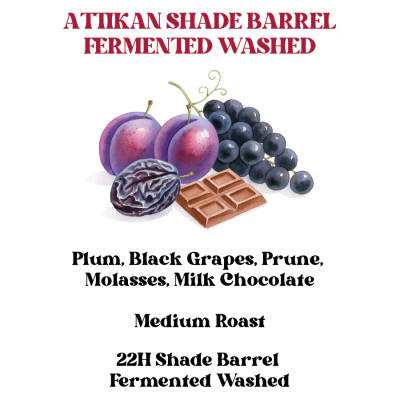
Attikan Shade Barrel Fermented Washed
Unrated

light roast · processed anaerobically for a period of 72 hours · Baba Budangiri Hills
Presenting our newest partner farm Jensuri situated in baba budangiri hills in chikmagalur, this is our second partner farm from the Kelechandra group and is situated at an elevation of 1478 MASL. This lot comes from the new Jensuri estate amongst the cluster of estates and is a microlot which was processed anaerobically for a period of 72 hours where ripest cherries with a brix of 22 plus were selectively handpicked, fermented and then dried on raised beds for a period of 22 days. This lot has been profiled with the approach of a higher development and a low drop temperature to amplify the sweetness while not adding to the body in the cup. The cup opens with an intensely sweet aroma, on the palate you will start with bright berries, complemented by kiwi and sweet orange notes on the mid palate and a blackberry and cane sugar like sweet finish which lingers on. The lot's high acidity and high sweetness make it ideal to shine in manual brews and is best enjoyed black.
5.0
With milk?
Unrated
Unrated
Unrated

Unrated

Processing & Flavors
One in five coffees in ICB's catalog now carries an experimental process tag. This is a reference guide to the four categories (anaerobic, carbonic maceration, double fermented, and experimental), covering how each works at the fermentation level, which Indian estates and regions produce them, and what the catalog data says about their flavor patterns.

Processing & Flavors
Carbonic maceration is the most widely misused term in Indian specialty coffee. It is a specific sub-type of anaerobic fermentation, not a synonym for it, and the distinction shows up in the cup. This field guide maps what CM is, where it happens in India, and what to expect from the 28 Indian coffees that carry the label.

Processing & Flavors
Every coffee ferments — the variable is how. Understanding the microbial chemistry behind washed, natural, and anaerobic processing explains why the same estate can produce a clean chocolate cup and a grape-forward lot from the same harvest. This article maps the mechanism to the label, with data from ICB's catalog of 1,238 Indian coffees.