

Full-bodied, clean, minimal sediment
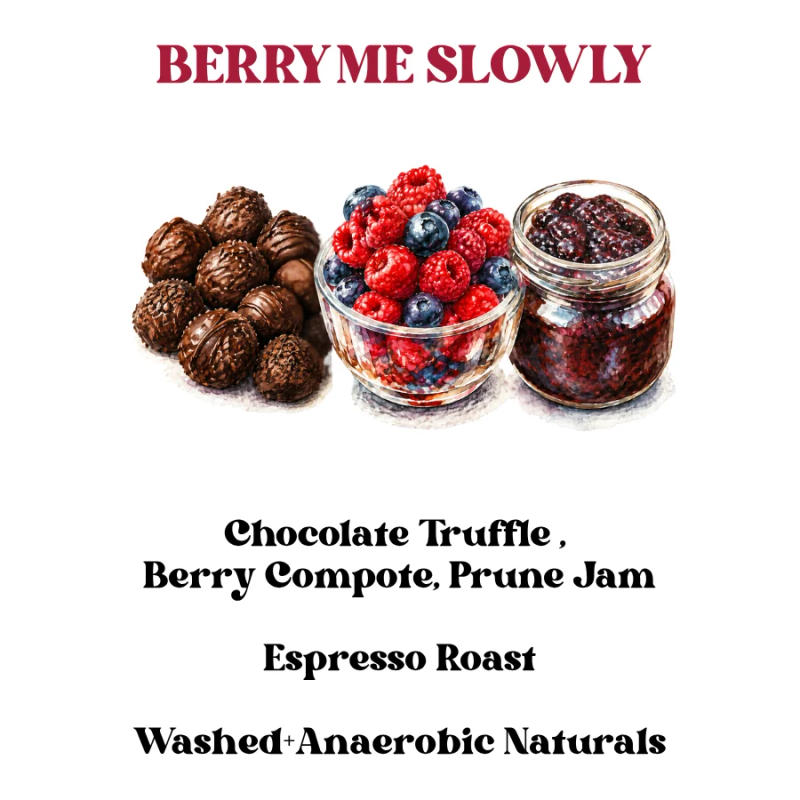
medium profile roast · washed coffee with an anaerobic natural
Flavour
Origin and production
- washed coffee with an anaerobic natural
As described by Rossette Coffee
Berry Me Slowly is our new espresso blend for people who like a bit more going on in their cup. We paired a washed coffee with an anaerobic natural and roasted both to a medium profile: the washed side keeps the cup clean and steady, and the anaerobic side adds a layer of berry. Expect chocolate truffle first, then berry compote, with the sweetness of prune jam underneath. It isn’t a funky coffee, but if you enjoy a hint of funk, you’ll find it in that berry. Acidity and body are balanced and the sweetness is generous, so it holds up whether you drink it straight or with milk. Pull it as espresso, stretch it into an Americano, or add milk and let the chocolate and jam carry through. It’s just as good from a Moka pot or a French press.
Brewing
Suggested for Espresso, French Press, Moka Pot. Works with milk (ICB's reading).
Intense, rich, syrupy, pseudo-espresso
Balanced, sweet, syrupy body with clear acidity
Pack sizes and price
Ratings
What drinkers say
With milk?
More from Rossette Coffee
Attikan Shade Barrel Fermented Washed
Unrated

Basankhan Fermented Washed
Unrated

Colombian Huila Decaf
Unrated
Dawn Cold Brew Blend
Unrated
Read about this

Brewing Behaviour
Espresso at Home with Indian Coffees: Washed, Natural, and Blend Behaviour
Indian coffee has a reputation for espresso reliability — dense beans, low acidity, chocolate-forward profiles that extract cleanly under pressure. That reputation holds, but only for one part of the catalogue. Washed, natural, and blend coffees behave differently enough under 9 bar that a single dial-in recipe will work for some and fail for others in ways that are predictable, once the pattern is clear.

Brewing Behaviour
Grind Size for Indian Coffee: How to Calibrate by Method and Roast
Grind size determines how fast water extracts from coffee — and for Indian specialty buyers, the standard per-method chart is a starting point, not a fixed answer. Thirty percent of ICB's catalog is light or light-medium roast, coffees that are denser and systematically underextract at standard chart settings. This reference covers the per-method calibration table, the Indian density adjustment, and how to read extraction feedback from the cup.

Brewing Behaviour
Why Your Specialty Coffee Tastes Flat (Common Extraction Issues)
Specialty coffee that tastes flat, weak, or sourly thin is almost always an extraction problem — not a coffee quality problem. This guide covers the six most common causes, with particular attention to Indian variables: hard tap water, RO-stripped water, mixer-grinder use, and tropical storage conditions.
Questions about this coffee
Rossette Coffee's tasting notes for Berry Me Slowly Blend lean toward Berry Compote, Chocolate Truffle and Prune Jam. Flavor is subjective and shifts with roast freshness, grind size, and brew method, so your cup may vary.
Berry Me Slowly Blend is suggested for Espresso, French Press and Moka Pot. As a rule of thumb: espresso needs a fine grind, pour-over and drip a medium grind, and French press or cold brew a coarse grind. Dial in from there to taste.