


The Indian Coffee Flavour Wheel: Reading Tasting Notes
The coffee flavour wheel is a three-tier map read from the centre outward. Laid over ICB's catalog, it shows where Indian specialty coffee actually sits: 70% of coffees carry a fruit note, chocolate is broad but shallow, and process and roast move a coffee across the wheel in predictable directions.

A bag that reads "cane jaggery, mulberry, cardamom" looks like three unrelated words. On a flavour wheel they are three addresses: one in the sweet segment, one among the berries, one in spice. Read that way, the list describes the shape of a cup. It is not a set of promises.
The usual assumption is that Indian coffee belongs to the chocolate-and-nut corner of that map, and that the wheel itself, built from Western references like blackcurrant and elderflower, has little to say about it. ICB's catalog does not support either half of that view. This guide covers the map itself: how the wheel is constructed, how ICB's own taxonomy adapts it with Indian descriptors, and where 1,359 active Indian coffees with mapped notes actually land. For the basics of what a tasting note is, see how to read coffee flavor notes.
How the flavour wheel is built
The reference most roasters work from is the Coffee Taster's Flavor Wheel. The Specialty Coffee Association of America published the first version in 1995. In 2016 it was rebuilt with World Coffee Research on the basis of the WCR Sensory Lexicon, a set of 110 flavour, aroma and texture attributes developed with the Sensory Analysis Center at Kansas State University. Each lexicon attribute has a written definition and a physical reference, a specific product at a set intensity, so that trained tasters can calibrate against the same thing.
The wheel arranges that vocabulary in three concentric rings. The inner ring holds nine broad categories: Fruity, Floral, Sweet, Nutty/Cocoa, Spices, Roasted, Green/Vegetative, Sour/Fermented and Other. The middle ring divides each into subcategories (Fruity splits into berry, dried fruit, citrus and other fruit). The outer ring holds specific descriptors such as raspberry, raisin or grapefruit.
The SCA's own guidance is to read from the centre outward and stop at whatever ring can be named with confidence. The design carries information too. Segments are coloured by visual association, so red fruits sit in red. And cells that touch are closely related, while a gap between cells means the panel found those descriptors less closely related. The "Other" segment is where papery, musty and chemical notes sit, which makes it the wheel's off-note zone.
Stopping at the inner ring is a correct reading. "Fruity" is a valid answer, "red fruit" is more specific, and "mulberry" is the most specific. Precision past the first ring is optional.
ICB's version: 14 families and an Indian edge
Every flavour note in ICB's catalog is mapped to a node in a three-tier sensory taxonomy that follows the same family → subcategory → descriptor structure as the wheel. It holds 344 nodes: 301 flavour descriptors across 13 flavour families, 29 attribute nodes covering acidity, body, mouthfeel, finish, sweetness and bitterness, and 14 defect or off-note nodes. Sixty-eight of those nodes are flagged as Indian reference points.
The taxonomy departs from the SCA wheel in four places. Nutty/Cocoa is split into Nutty and Chocolatey/Cocoa, because chocolate is too common on Indian bags to share a segment. Brown sugar gets its own Caramelized family instead of sitting inside Sweet. Earthy/Savory becomes a family, since monsooned and robusta lots need one and the SCA wheel has nothing equivalent outside "Other". And attributes and defects are kept apart from flavour, so "syrupy body" and "woody" are not counted as tastes.
Spice is the most localised family: 14 of its 27 nodes are Indian-flagged. Indian descriptors are not a separate wheel. They are leaves on the same tree, attached where their flavour belongs:
| Descriptor | Path on the wheel | Coffees in catalog |
|---|---|---|
| Cane Jaggery | Sweet → Jaggery | 45 |
| Cardamom | Spice → Sweet Spice | 12 |
| Hibiscus | Floral → Light Floral | 12 |
| Tamarind | Earthy/Savory → Indian Savory | 8 |
| Lemongrass | Herbal/Vegetal → Indian Herbs | 6 |
| Jamun | Fruity → Indian/Regional Fruits | 5 |
| Amla | Fruity → Indian/Regional Fruits | 4 |
| Sapota (Chikoo) | Fruity → Tropical | 4 |
| Ginger | Spice → Indian Masala | 4 |
| Champak | Floral → Indian Floral | 3 |
Tamarind is filed under Savory rather than Fruit because its sour depth reads savoury in the cup, closer to the earthy segment than to citrus.
Across the catalog, 187 of 1,359 mapped coffees (13.8%) carry at least one Indian-flagged descriptor, and cane jaggery leads at 45 coffees. Indian references are still a minority vocabulary: fewer than one bag in seven uses one, and jaggery alone accounts for about a quarter of those. Some Indian-flagged terms, such as jasmine, rose and mulberry, also appear on the SCA wheel; the flag marks a familiar reference point, not a gap in the global vocabulary. The descriptors genuinely absent from the SCA wheel run from jaggery and cardamom to single appearances of mishri, gulkand, mogra, kokum, mahua and areca nut. The outer ring is still being written. Roasters have taken the same approach: Blue Tokai's Indian Flavour Wheel builds on the SCA base with tulsi, chikoo, cardamom and fennel.
One washed, medium-roast lot shows how a single bag spans several segments. Dark chocolate sits in Chocolatey/Cocoa, jackfruit in Fruity, cardamom and spice in Spice, and brown sugar in Caramelized: four families, two of them reached through Indian reference points.

Where Indian coffee sits on the wheel
Count how many coffees carry at least one descriptor from each family, and the chocolate-first assumption does not hold:
| Family | Share of coffees | Descriptors in use |
|---|---|---|
| Fruity | 70.1% | 83 |
| Chocolatey/Cocoa | 42.2% | 7 |
| Nutty | 28.0% | 14 |
| Sweet | 26.6% | 29 |
| Caramelized/Brown Sugar | 19.8% | 8 |
| Spice | 16.9% | 14 |
| Roasted/Smoky | 15.5% | 5 |
| Floral | 14.1% | 20 |
| Earthy/Savory | 7.6% | 9 |
| Fermented/Funky | 6.9% | 9 |
| Herbal/Vegetal | 5.2% | 10 |
Separately, 24% of bags carry an attribute term such as bright acidity or full body.
Look at the descriptor counts as well. Chocolate reaches 42% of coffees using only seven descriptors. Fruit reaches 70% using 83. Roasters treat chocolate as a broad base note and use fruit to differentiate one lot from another, which is why the fruit segment of an Indian bag is usually its most specific part. For a buyer comparing two Indian coffees, a shared "dark chocolate" says little; the fruit notes are where the labels actually diverge. At the subcategory level, the most common addresses are Chocolate (436 coffees), Nuts (372), Citrus (352), Berries (325), Dried Fruit (240) and Stone Fruit (230).
This figure differs from the "about 35% fruity" estimate in ICB's beginner guide, and both are accurate. That estimate counted individual notes; this one counts whether a coffee carries any fruit note at all. Fruit is present on most bags but rarely alone.
The average coffee carries 3.48 mapped notes spread across 2.55 families. About 17% sit in a single family, 32% in two, 29% in three and 20% in four or more. A typical Indian bag describes a cluster of neighbouring segments rather than a single point.
Method note: these figures cover 1,359 active coffees with at least one mapped note, out of 1,566 active coffees in ICB's catalog, queried in October 2026. They describe how Indian coffees are labelled by their roasters, not panel-verified cup scores.
How process moves a coffee around the wheel
Processing shifts where a coffee lands more visibly than any other variable in the catalog. Share of each process's coffees carrying a note in each family:
| Process (coffees) | Fruity | Chocolate | Nutty | Spice | Earthy | Fermented |
|---|---|---|---|---|---|---|
| Washed (352) | 66% | 51% | 35% | 20% | 5% | 1% |
| Natural (189) | 92% | 28% | 23% | 12% | 4% | 6% |
| Honey (85) | 81% | 35% | 25% | 14% | 7% | 9% |
| Anaerobic (135) | 96% | 33% | 16% | 16% | 4% | 11% |
| Carbonic maceration (33) | 100% | 18% | 15% | 12% | 3% | 18% |
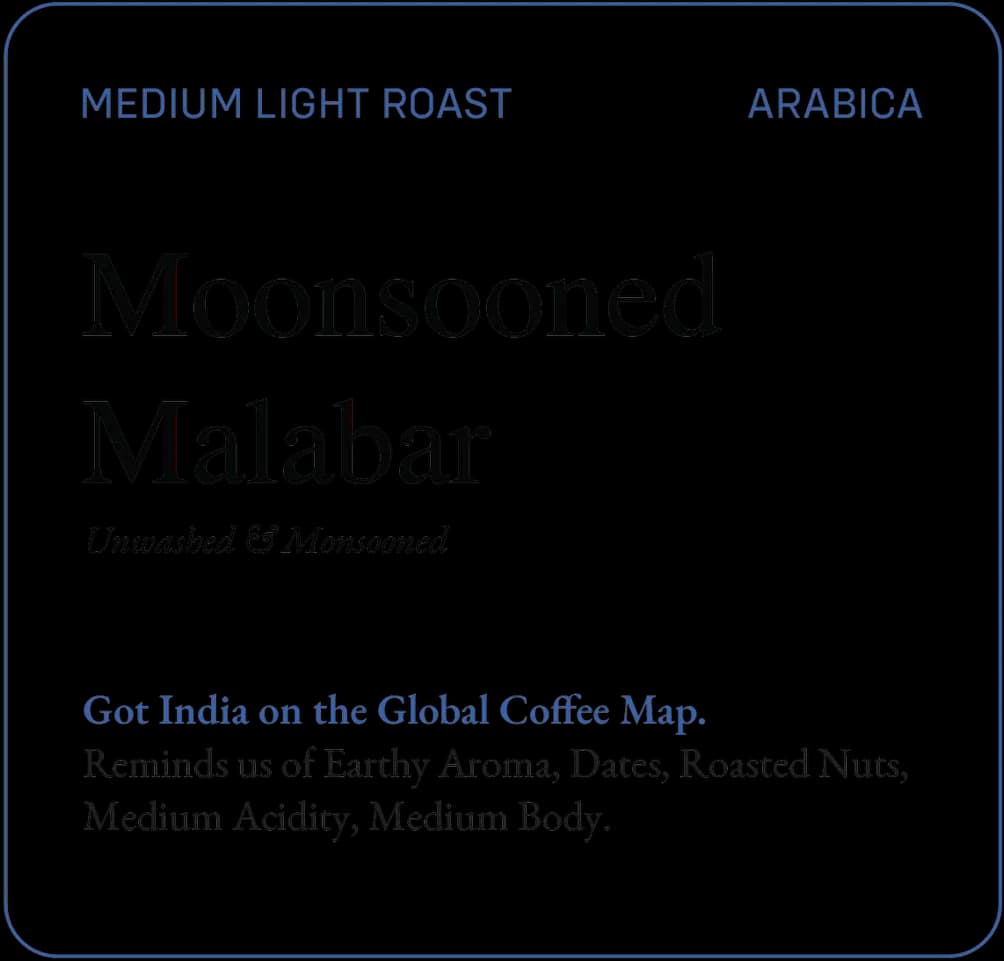
| Monsooned (31) | 16% | 58% | 45% | 45% | 48% | 3% |
Monsooned coffee is the only process that moves off the fruit segment almost entirely: fruit drops to 16%, while Earthy (48%), Spice (45%) and Nutty (45%) take its place. That matches what Monsooned Malabar is known for, a low-acid, heavy cup, but the data shows how completely it relocates on the map.
Fermentation-led lots go the other way and stay on the fruit segment. Fruit appears on 96% of anaerobic and every carbonic maceration coffee, while the Fermented/Funky family appears on only 11% and 18% respectively. Roasters describe fermentation mostly through the fruit it produces, not through winey or boozy terms. Experimental processing is being sold in a familiar vocabulary, so a label rarely signals in advance that a cup may taste fermented.
Washed coffees have the most even spread across families and almost never carry fermented descriptors (1%). On the wheel they are the closest thing to a neutral starting point.
How roast moves a coffee around the wheel
Roast rotates a coffee from the bright side of the wheel toward the roasted side, but not uniformly.
| Roast (coffees) | Fruity | Floral | Chocolate | Nutty | Roasted/Smoky |
|---|---|---|---|---|---|
| Light (229) | 90% | 30% | 19% | 14% | 6% |
| Light-medium (227) | 89% | 23% | 29% | 16% | 9% |
| Medium (393) | 75% | 9% | 44% | 35% | 17% |
| Medium-dark (225) | 57% | 5% | 68% | 44% | 25% |
| Dark (146) | 27% | 3% | 66% | 37% | 34% |
Floral notes fall tenfold between light (30%) and dark (3%), the steepest decline of any family. Fruit never disappears: it still appears on 27% of dark roasts. What changes is the kind of fruit. Among fruit-noted coffees, berries fall from 42% at light roast to 18% at dark, while dried fruit rises from 18% to 33%. As roast develops, the fruit on the label moves from fresh to cooked and dried. A fruit note on a dark roast is therefore not a labelling error in itself; the kind of fruit is the better test.
This gives a simple check when reading a label. A dark roast listing raisin or dates sits where the data expects it. A dark roast listing jasmine is an outlier. For how Indian roasters approach each level, see roast levels in the Indian context.
Regions on the wheel
Regional figures need more care, because each region's catalog reflects its process and roast mix as much as its terroir. With that caveat, regions with at least 25 mapped coffees sit in recognisably different places:
| Region (coffees) | Fruity | Chocolate | Nutty | Spice | Fermented |
|---|---|---|---|---|---|
| Chikmagalur (345) | 75% | 48% | 28% | 17% | 6% |
| Coorg (111) | 59% | 32% | 33% | 30% | 3% |
| Baba Budangiri (100) | 76% | 22% | 19% | 19% | 15% |
| Sakleshpur (50) | 88% | 26% | 22% | 16% | 14% |
| Koraput (42) | 71% | 50% | 52% | 14% | 12% |
| Palani Hills (30) | 60% | 40% | 47% | 23% | 3% |
Coorg has the highest Spice share (30%) and the lowest Fruity share (59%) of these regions. Koraput and Palani Hills lean nutty, at 52% and 47%. Baba Budangiri lists chocolate far less often than neighbouring Chikmagalur (22% against 48%) and carries more fermented descriptors (15%), which reflects its share of experimental lots more than any difference in soil.
A common explanation for spice in Indian coffee is that it grows beside pepper and cardamom and absorbs their character. No published evidence supports flavour transfer from intercropping. In ICB's data, spice tracks process more clearly than geography: it appears on 45% of monsooned coffees and 12% of naturals. Across all three tables, fruit ranges from 16% to 100% by process but only from 59% to 88% by region. On the wheel, how a coffee was processed says more than where it was grown.
The parts of a bag that aren't flavour
Some words on a label do not belong on the wheel at all. About a quarter of bags include attribute terms such as bright acidity, juicy mouthfeel, syrupy body or long finish. These describe the structure of a cup, how it feels rather than what it tastes like, and are best read separately from the flavour notes.
Off-notes are a third category. "Woody" appears on 17 coffees in the catalog and "musty" on two, both monsooned. On the SCA wheel these sit in the Other → Papery/Musty segment. In monsooned coffee they are part of the expected profile. On a light washed coffee, the same word would be worth noticing.

Reading a bag outside-in
The wheel is designed to be read from the centre outward while tasting. A label can be read in the opposite direction, from the specific word back to its family.
Sort the words
Separate attribute terms (acidity, body, mouthfeel, finish) from flavour notes.
Walk each note inward
Mulberry → berries → fruity. Cane jaggery → jaggery → sweet. Tamarind → Indian savory → earthy/savory.
Count the families
One or two families usually describe a focused cup; four or more point to a layered or experimental lot.
Check against roast and process
Floral notes on a dark roast, or fresh berries on a monsooned lot, sit outside where the catalog usually places those coffees and are worth questioning.
A seven-note co-ferment works as a practice case. Rose and mogra sit in Floral, bergamot in Fruity (citrus), black tea in Herbal, vanilla and honey in Sweet, and cardamom in Spice. That is five families, which places it among the most layered fifth of the catalog. Because it is a co-ferment, some of those aromatics come from the material fermented alongside the coffee.

References
- Specialty Coffee Association — Coffee Taster's Flavor Wheel
- Specialty Coffee Association — How to Use the Coffee Taster's Flavor Wheel in Eight Steps
- World Coffee Research — Sensory Lexicon