


Vietnamese Phin Filter Brewing with Indian Robusta
Vietnamese coffee is a brew method and a drink, not a bean origin. This guide covers how the phin works, why dark robusta suits it, which Indian robusta to look for, and how to read drip time to fix a cup that runs too fast or stalls.

Vietnamese coffee is dark-roast robusta brewed slowly through a small metal drip filter called a phin, usually straight onto sweetened condensed milk. A standard cup uses about 14 g of medium-fine coffee and 120 ml of hot water, and takes 4–6 minutes to drip through. It is served hot (cà phê sữa nóng) or poured over ice (cà phê sữa đá).
Most recipes assume the beans come from Vietnam. They do not need to. India grows far more robusta than arabica, roughly 78% of national output by volume, and ICB's catalog currently lists 60 in-stock coffees that are 100% robusta, from 37 roasters. The device will also feel familiar to anyone who brews kaapi at home: gravity, a perforated metal disc, a strong concentrate, milk and sugar. A phin has no dial or timer, and the only feedback it gives is how long the water takes to drip through. Most of what follows is about reading that number.
What a phin filter is
A phin is a single-cup metal drip brewer with four parts: a base plate that rests on the rim of a glass, a perforated brew chamber, a press (also called an insert) that sits on top of the grounds, and a lid. Water poured into the chamber passes through the coffee by gravity. There is no paper filter, so oils and a small amount of fine sediment reach the cup, which gives the drink its weight.
The press does two jobs. It holds the grounds down so they do not float when water is added, and it restricts flow so the water spends a few minutes in contact with the coffee instead of running straight through. Phins come in two designs. A gravity insert simply rests on the grounds, so the grind alone sets the flow rate. A screw-down press threads onto a central post, which lets you set how firmly the coffee is packed, and gives one more control.
What comes out is a concentrate. Fourteen grams of coffee to about 120 ml of water is close to 1:8 by weight, roughly twice the strength of a pour-over. It is made that way because condensed milk, ice, or both will dilute it in the glass.
Phin and South Indian filter: Both are gravity percolators with perforated metal discs, and both make a concentrate rather than a finished drink. The phin brews one cup in about five minutes directly over the glass. The South Indian filter brews a household decoction at about 1:5–1:6 over 10–25 minutes, which is then mixed with hot milk. Someone who can read a slow or fast kaapi filter already knows how to read a phin.
Why robusta, not arabica, for a phin
Most recipes present robusta as tradition. The reason it works is in the bean's composition. Robusta carries roughly 1.8–2.7% caffeine by dry weight against about 1.0–1.5% for arabica, more chlorogenic acids (7–10% against 5.5–8%, per Compound Interest's comparison), less sugar and fewer lipids. Caffeine and the breakdown products of chlorogenic acids are bitter, and with less sugar to round them off, the cup tends toward bitterness, heavy body and low acidity. ICB's arabica and robusta comparison covers the species difference in detail. Neither is the better coffee; they suit different drinks.
Sweetened condensed milk is why robusta suits this one. The milk is very sweet and dense, and the drink often goes over a glass of ice. A bright, light-roast arabica turns thin and sour-sweet under that much sugar and then gets diluted further as the ice melts. Dark robusta's bitterness and body still come through both. Indian filter blends follow the same logic: they are built around dark-roast robusta because it holds up against hot milk and sugar.
Coffee came to Vietnam in the French colonial period, robusta suited the Central Highlands (which still grow more than 80% of the country's coffee), and canned condensed milk kept without refrigeration in a hot climate.
Roasting style differs: Many mass-market Vietnamese blends are roasted with butter, vegetable oil, sugar or other additions, which leaves a glazed, caramel note in the cup. Indian specialty robusta is roasted without additives. The cup is cleaner, and its bitterness comes from the bean rather than a roast coating.
Sourcing Indian robusta for phin brewing
Robusta grows in India from near sea level to around 800–1,100 m, mostly below the arabica belt. Coorg (Kodagu) is the largest robusta district by a wide margin, at about 104,800 tonnes of the roughly 240,000 tonnes of robusta India produced in 2020–21, according to Coffee Board of India data. Wayanad in Kerala follows at about 59,500 tonnes, then Chikmagalur at about 44,500 tonnes. These are the same districts that supply India's filter-coffee blends, A phin brewed with Indian robusta draws on the country's largest coffee crop, not a niche one.
ICB's catalog, as of October 2026, lists 60 in-stock coffees that are 100% robusta, from 37 roasters. Counting blends that contain robusta (80/20, 70/30, 60/40 and 50/50 arabica-robusta), the number rises to 117 coffees from 51 roasters. In April 2026 the catalog held 42 robusta coffees. Specialty listings are growing, but they remain a small share of what India grows. Robusta is roughly three-quarters of the national harvest but about 4% of ICB's in-stock catalog (60 of 1,493 coffees). That gap comes from what roasters choose to list.
Among the 60 single-species robusta coffees:
Roast levels of in-stock 100% robusta coffees on ICB (October 2026)
| Roast level | Coffees |
|---|---|
| Medium-dark | 20 |
| Medium | 16 |
| Dark | 11 |
| Light-medium | 6 |
| Light | 1 |
| Not stated | 6 |
Thirty-one of the 60 are medium-dark or dark, the range a traditional phin cup is built around. Most of the rest sit at medium or lighter. Those roasters are treating robusta as an origin coffee to taste on its own, which is a different aim from the Vietnamese cup. Where a region is listed, Coorg accounts for 14, Chikmagalur 9, Baba Budangiri 4, Wayanad 4 and Sakleshpur 3. The most frequent flavour notes are dark chocolate and nuts (14 coffees each), then chocolate (9) and caramel (7).
Process matters as much as roast here. Washed robusta (10 of the 60) tends to read cleaner and more chocolate-led. Natural (12) and anaerobic (9) lots add dried fruit and fig, which still come through condensed milk but can taste winey when drunk black. For the classic sweet cup, medium-dark or dark roasts are the closest match. Arabica-robusta blends such as 80/20 give a softer, less bitter entry point.
ICB does not tag coffees for the phin. The nearest signals are robusta that roasters tag for South Indian filter (14 of the 60) or moka pot (21), both of which use a similar grind. One listing in the catalog is sold explicitly as a Vietnamese-style blend: a medium-dark Chikmagalur blend from Bili Hu. With one listing named for the drink, Vietnamese coffee in India is still something people brew at home rather than a product category. The beans for it are already on sale under other labels.
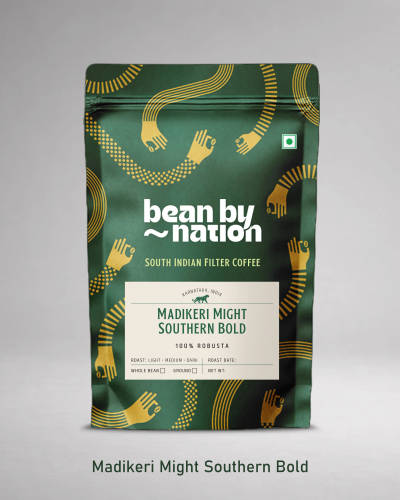
Medium-Dark and Dark Robusta on ICB





Grind size and drip time
A phin needs a medium-fine grind, close to the moka pot band of roughly 400–600 µm and finer than pour-over (550–850 µm). It overlaps the coarser end of a South Indian filter grind (350–550 µm). The texture is close to fine sand. ICB's grind size reference has the full method table, and the grind size converter translates the moka band into grinder settings.
Grind too fine and fines pass through the holes or clog them, so the drip slows or stops. Grind too coarse and the water runs through in under two minutes, leaving a weak, sour cup.
Phin starting recipe (one cup)
| Method | Grind | Ratio | Time | Notes |
|---|---|---|---|---|
| Phin starting recipe (one cup) | Medium-fine, 400–600 µm | About 1:8 | 4–6 minutes | water: About 120 ml; bloom: 20–30 ml water, 30–40 seconds; first drop: Before about 2 minutes |
Water should be 93–96 °C, which is just off the boil at sea level. At altitude a just-boiled kettle is already cooler (about 97 °C in Bengaluru), so it needs little or no rest; ICB's water temperature guide lists boiling points for Indian cities.
Step-by-step brew method
Add the milk
Spoon 1–2 tablespoons (about 20–40 g) of sweetened condensed milk into a heatproof glass.
Load the phin
Set the base plate and chamber on the glass. Add 14 g of medium-fine coffee and shake gently to level it.
Set the press
Place the press on the grounds. For a screw-down press, turn until it meets resistance, then back off slightly.
Bloom
Pour 20–30 ml of water at 93–96 °C and wait 30–40 seconds while the grounds swell.
Fill
Top the chamber up to the rim with the remaining water (about 90–100 ml) and put the lid on.
Watch the drip
The first drops should fall within about two minutes, and the chamber should empty in 4–6 minutes in total.
Stir and serve
Lift the phin off and rest it on its upturned lid. Stir the coffee into the condensed milk. Served this way it is cà phê sữa nóng.
For the iced version, cà phê sữa đá, brew the same way, stir in the condensed milk, then pour over a tall glass packed with ice. The melting ice is part of the recipe, which is why the brew starts as a concentrate. For iced black coffee (cà phê đen đá), skip the milk, stir in sugar while the coffee is hot and pour over ice. Condensed milk is a common pantry item in India; start with one tablespoon and adjust. The blended, frothy drink most Indian cafes call cold coffee is a different preparation, covered in ICB's guide to Indian cold coffee at home.
Troubleshooting a phin
Read drip time and taste together. Each points to a different fix.
Phin troubleshooting
| What happens | Likely cause | Adjustment |
|---|---|---|
| Drips through in under 2 minutes; weak or sour cup | Grind too coarse, under-dosed, or press too loose | Grind finer, use a full 14 g, tighten a screw-down press |
| Stalls, or takes 8 minutes or more; harsh cup | Grind too fine, or press too tight | Grind coarser, loosen the press; a light tap on the chamber can restart the drip |
| Grounds in the cup | Press not seated flat, or too many fines | Level the bed before setting the press; check the grinder for fines |
| Bitter at a normal drip time | Roast too dark to drink black, or water too hot | Add condensed milk, or drop the water a few degrees |
| Thin or flat through milk | Roast too light, or an arabica | Move to a medium-dark robusta or a robusta-heavy blend |
Change one thing per brew: Note the drip time, change either the grind or the press, and compare the next cup against it.