


Shevaroys Coffee: Tamil Nadu's Overlooked Growing Region
The Shevaroy Hills above Yercaud have grown arabica since the 1820s, yet the region is rarely named in guides to Indian coffee. In ICB's catalogue it is the fifth-largest named origin, with 42 listings from 17 roasters and one of the most fermentation-forward process profiles in the country.

Most guides to Indian coffee give the Shevaroys a short paragraph, usually after the Nilgiris. The description tends to be the same: a small Tamil Nadu hill origin, low volume, mild in the cup, seldom seen in specialty retail.
ICB's catalogue does not support most of that. Of 1,651 coffees listed, 42 carry the region label Shevaroy Hills, from 17 roasters. That makes it the fifth-largest named origin in the catalogue, behind Chikmagalur, Baba Budangiri, Coorg and Sakleshpur, and ahead of Koraput (38), Palani Hills (33) and Araku Valley (19). Nor are the cups mild. Most of these coffees are naturals or fermented lots, and their tasting notes are mostly fruit.
The region is small and easy to skip in a guidebook. On a shelf it is not hard to find. This guide covers where the hills are, who farms them, how the coffee is processed and what the labels say about the cup.
Where the Shevaroys Are (and Why They Aren't the Western Ghats)
The Shevaroy Hills rise above the plains of Salem district in northern Tamil Nadu. Yercaud is the main town. The range covers about 400 km², with plateaus between roughly 1,200 and 1,500 m and a high point at Solaikaradu, around 1,620 m.
They are part of the southern Eastern Ghats, not the Western Ghats. Most Indian coffee grows on the Western Ghats, the long range that runs down the west coast through Karnataka, Kerala and the Nilgiris. The Eastern Ghats are a broken chain of separate hill blocks running down the other side of the peninsula. The Shevaroys are one of those blocks, east of the Nilgiris and detached from them. Their forests share some species with the Western Ghats, but geologically and climatically they are a separate system. That puts the Shevaroys in the same group as Araku Valley and Koraput, India's other Eastern Ghats coffee origins.
One place, four spellings: Shevaroys, Shevaroy Hills, Servarayan Hills and Sheveroys all refer to the same range. "Yercaud" on a bag almost always means the same hills, named after the town. ICB files all of them under Shevaroy Hills.
Altitude, Rainfall and Scale
The Coffee Board's regional profile places Shevaroys coffee between 900 and 1,500 m, with annual rainfall of 800–1,500 mm. That rainfall is at the low end for Indian coffee: Chikmagalur gets 1,000–4,500 mm and the Nilgiris 1,600–2,600 mm. The Board lists arabica as the crop, S.795, Cauvery and Sln.9 as the main varieties, and orange, banana and pepper as intercrops. Estate pages add Chandragiri, Sln.5B and Catimor, along with jackfruit, mango, avocado and clove trees between the coffee rows. Named estate altitudes sit near the top of the range: Orchardale at about 1,500 m, Kudiraipanjan and Nachammai at about 1,400 m.
The area under coffee is small. The Coffee Board puts it at about 5,000 hectares, producing about 3,000 tonnes in an average year. NRSC's 2024 satellite mapping, held in ICB's region records, measures 8,485 hectares of plantation. For comparison, the same NRSC mapping gives Chikmagalur 106,654 hectares. Measured against NRSC area, the Shevaroys put more coffees on ICB per hectare than Chikmagalur does (42 from 8,485 ha, against 395 from 106,654 ha), so the region's low profile is not a shortage of coffee reaching roasters. Harvest runs from November to February, and the soils are mostly red loam.
Why two area figures: The Coffee Board figure is a long-standing, self-reported regional total. The NRSC 2024 figure is plantation extent mapped from satellite imagery. They count different things, so the gap between them is not an error.
An Estate-Family Origin Since the 1820s
Coffee is usually traced to M.D. Cockburn, the Salem district collector from 1820 to 1829, who is credited with the first plantings near Yercaud. Accounts differ on where his plants came from, and the Grange Estate is usually, though not definitively, named as the first site. Cockburn's name comes up again in the Nilgiris, where a Kotagiri estate is attributed to him in 1843.
Many of the estates still sending coffee to roasters have long histories, and most are run by families. Kudiraipanjan was established in 1878 by the British planter James Frederick MacFarlane. Palani Kandasamy Chettiyar arrived in the hills in 1923 to trade coffee and oranges with the British estates, and his family bought Kudiraipanjan in 1975. The estate now carries NPOP organic certification. The MSP group, run by the Rajes family for four to five generations, has grown coffee in the Shevaroys since the 1920s and operates seven estates near Yercaud, including Orchardale, Stanmore, Gowri and Cauvery Peak.
This structure is different from the Eastern Ghats peers. Araku and Koraput coffee reaches roasters largely through tribal cooperatives that aggregate smallholder cherry. Shevaroys coffee reaches them estate by estate, under estate names. That is the main reason the region stays unnamed: the estate is what a buyer sees on the bag, and the hills are the background.
The farm roaster: Hill Tiller Coffee Roasters roasts on the farm at Moganad Estate, Yercaud, and is linked to the MSP group. It accounts for 16 of the 42 Shevaroys listings on ICB. No other route in the region runs as directly from estate to cup.
What ICB's Catalogue Shows
The 42 Shevaroy Hills listings (40 in stock) make up 2.5% of ICB's catalogue. They are concentrated in one roaster. Hill Tiller holds 16, Hill Groove 4, Shodh and Blue Tokai 3 each, and Ikkis, Bloom and Home Blend 2 each. Ten more roasters list a single coffee. Leaving Hill Tiller out, the region still has 26 listings across 16 roasters, more than Araku Valley's total.
Eight estate names account for nearly every listing: Orchardale (9), Stanmore (7), Kudiraipanjan (6), Moganad (5), Bison Valley (4), Riverdale (3), Gemblary (3) and Gowri (2). Kudiraipanjan travels furthest outside its owner's own channels. Shodh, Kaffenum, Kali and BrewClan all list it, and so does Grey Soul under the name "Shevaroys Washed". Shevaroy Hills coffee also goes into eight multi-region blends from Blue Tokai, Beachville and Bloom, mostly paired with Chikmagalur.
Of the 42 listings, 36 are arabica and one is robusta. Where a variety is named, SLN 9 (14 listings) and SLN 795 (11) dominate, followed by Catimor (3). One Gesha lot comes from Riverdale Estate, sold by Blue Tokai.
Regions for comparison: Shevaroy Hills (42 listings), Koraput (38), Palani Hills (33), Araku Valley (19), Nilgiris (about 5)
A Fermentation-Forward Origin
The processing labels are where the Shevaroys differ most from other Indian origins.
Grouping experimental, anaerobic, double-fermented, carbonic maceration, honey and washed-natural lots together, 18 of 42 Shevaroys listings (43%) carry an experimental-family process. The catalogue-wide figure is 32%. Chikmagalur sits at 34%, Coorg at 36%, Koraput at 24% and Araku at 16%. Naturals and experimental lots together make up 69% of Shevaroys listings. Washed coffee, the default for most Indian arabica, is 19%, against 25% across the catalogue. Roasters appear to buy from the Shevaroys for processing experiments more than for classic washed arabica.
Some roasters label lots by fermentation time. Hill Groove's Orchardale and Bison Valley lots are named "650+ Hrs" and "900+ Hrs Alt Multi Fermented Naturals". Labels like these suggest estates are processing deliberately for buyers who want experimental lots.
The data does not say why the region leans this way. Two factors are plausible. The low rainfall and dry harvest months give estates a more dependable window for drying whole cherry slowly. And because a single family controls growing, processing and in some cases roasting, it can run small trials without going through a cooperative.
What Shevaroys Coffee Tastes Like
Among the 37 Shevaroys listings that publish tasting notes, 34 (92%) name at least one fruit. Sweetness notes such as toffee, caramel, honey and cane sugar appear on 18, chocolate or cocoa on 15, nuts on 9, floral or tea notes on 7, and rum or wine-like notes on 6. The most frequent individual notes are fresh berry (6 listings), followed by toffee, raisin, cherry and dark chocolate (5 each).
Process explains most of the split. Washed lots lean towards chocolate, nuts and dried fruit. Home Blend's Gemblary Estate washed lists cocoa powder, dried fruit and nuts; BrewClan's Kudiraipanjan washed lists almond, dark chocolate and nutmeg. Naturals and fermented lots carry the berry, cherry, rum and jasmine. The older description of the region, mild body and a clean, gently spiced finish, matches the washed and export-grade side of the region. It no longer describes most of what Indian roasters sell under the name. A buyer going by an older regional guide would expect a different coffee from the one most likely to arrive.
Ratings are too thin to support any claim about quality: six coffees have been rated, with seven ratings between them.

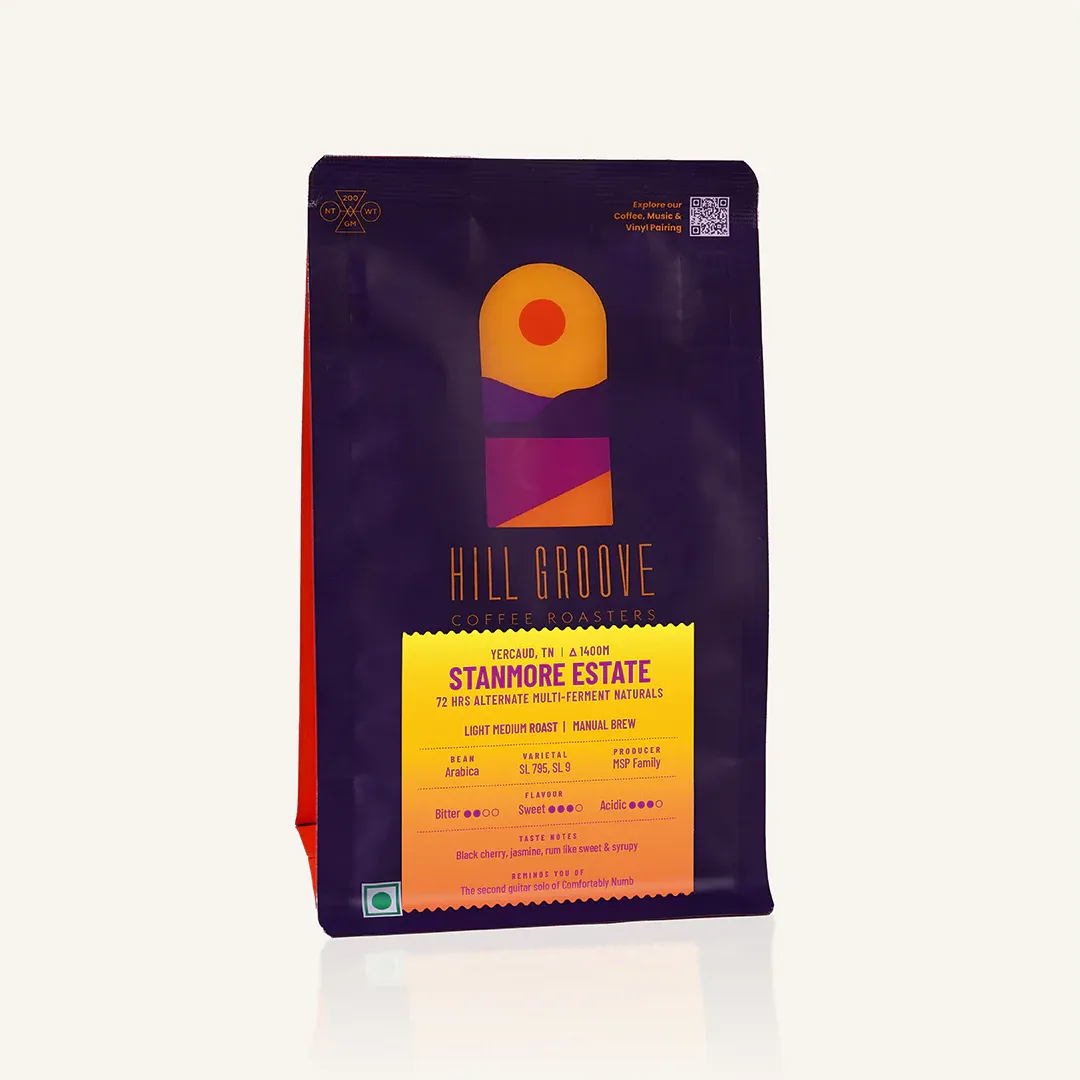
How to Read a Shevaroys Label
Find the estate name
Orchardale, Stanmore, Kudiraipanjan, Moganad, Bison Valley, Riverdale, Gemblary and Gowri say more about a lot than "Yercaud" does, because each estate runs its own processing.
Read the process
Washed lots on ICB tend towards chocolate, nuts and dried fruit. Naturals, anaerobic and multi-fermented lots tend towards berry, cherry and rum.
Check the roast
22 of the 42 listings are medium roasts. The 13 light and light-medium lots are where the fruit notes show most clearly.
Don't look for a GI logo
The Shevaroys hold no geographical indication. India's regional coffee GIs cover Coorg, Chikmagalur, Bababudangiri, Araku Valley and Wayanad Robusta. On a Shevaroys bag the region name describes origin only and carries no legal protection.
Where the Shevaroys Fit
Tamil Nadu has three coffee hill systems on ICB. The Shevaroys have 42 listings, the Palani Hills 33 and the Nilgiris about five. Of the three, the Shevaroys have the largest shelf presence and the most experimental processing. The region's low profile comes mostly from how its coffee is sold: buyers see Orchardale or Kudiraipanjan on the bag, and the name of the hills those estates sit in rarely appears.