


Koraput Coffee: The Odisha Highland Region
Koraput sits in the Eastern Ghats of southern Odisha at 900–1,370m, where tribal smallholders have grown Arabica under native forest canopy for generations. Most coverage of the region frames it as a social development story. ICB's catalog tells a different one: 35 active coffees across 10 roasters, a distinct chocolate-caramel-nutty flavor signature, and two Fine Cup Awards at the Flavour of India 2024 competition — the first dual recognition for an Odisha origin in national coffee competition.

In April 2025, at the India International Coffee Festival in Bangalore, the results of the Flavour of India Fine Cup Award 2024 were announced. Koraput, a highland district in southern Odisha barely known to specialty buyers outside the region, won in two separate categories: Arabica Washed and Arabica Natural. It placed fourth overall among all Indian origins evaluated that year. It was the first time an Odisha coffee had received dual recognition in this competition.
The coverage that followed was mostly development narrative: tribal farmers, government cooperatives, livelihoods transformed. That story is accurate — and separate from what matters to a specialty buyer. Koraput's 35-coffee catalog, the flavor data behind it, and the ten roasters now sourcing from the origin describe something more specific: an Eastern Ghats Arabica with a coherent terroir character, a washed-dominant processing profile, and a cup clearly distinct from its better-known neighbor, Araku Valley.
This article covers Koraput as a coffee origin: where it grows, what it tastes like, how it is produced, and which roasters are active there.
Where Koraput sits and why it grows coffee
Koraput district occupies the southern edge of Odisha, where the state meets Andhra Pradesh and Chhattisgarh. The terrain is part of the Eastern Ghats, an older and less continuous mountain range running along India's east coast, geologically distinct from the Western Ghats where Karnataka and Kerala produce the bulk of Indian specialty coffee.
Coffee grows across eight blocks in the district at elevations of roughly 900–1,370m. Deomali, at 1,672m the highest peak in Odisha, rises within the district boundary; the primary cultivation zones are lower, concentrated in Semiliguda, Deomali block, Kindiriguda, and the surrounding forested terrain.
The growing conditions differ from the Western Ghats. Annual rainfall averages 1,500–2,000mm, adequate for Arabica but lower than the 2,500–4,000mm that Chikmagalur or Coorg receives. Cloud cover is less persistent. Temperature variation between day and night is more pronounced. The soils are laterite and red loamy, enriched by organic matter from forest-canopy decay. Coffee grows under native shade trees, not planted monocultures but working forest, so most cultivation zones need no synthetic pesticides.
Altitude comparisons: 1,000m in the Eastern Ghats is not the same growing environment as 1,000m in the Western Ghats. Rainfall, cloud cover, and temperature range all differ between the two systems. The geography and flavor article covers this in detail; the short version is that altitude is one variable among several, and cross-mountain comparisons without accounting for microclimate can mislead.
Slow cherry ripening is the product of these conditions taken together: altitude, forest shade, and mineral-rich laterite soil. The nutty-sweet-chocolate character that appears consistently across Koraput's catalog reflects this more than any single processing decision. The harvest window runs November through January.
From watershed to specialty shelf: a 90-year arc
Koraput's coffee history did not follow the Karnataka or Kerala pattern. There were no British planters establishing estates in hill tracts. The origin story is more indirect.
In the 1930s, the Maharaja of Jeypore, Rajbahadur Rama Chandra Deo, established the first coffee plantation in the district. It is documented but not celebrated; the plantation did not achieve commercial scale. A second attempt came in 1958, after zamindari abolition, when the state soil conservation department planted coffee to prevent siltation in the Machkund river basin. The rationale was watershed protection, not commerce.
For decades after, coffee existed in Koraput as a subsistence crop. Tribal farmers growing under forest shade harvested cherry and sold it to middlemen from neighboring Andhra Pradesh at ₹10–15 per kg. No processing infrastructure existed within the district. No brand. The value left the region.
The commercial phase began in 2019, when the Tribal Development Co-operative Corporation of Odisha Ltd (TDCCOL), a state government enterprise, established a curing centre, roasting and grinding unit, and packaging facility in Koraput at a cost of ₹50 lakh. Procurement price rose to ₹35–45 per kg. Output was sold under the "Koraput Coffee" brand through Adisha outlets (Odisha's government retail chain) and Amazon. Farmers who had previously sold to intermediaries now had a guaranteed buyer at more than twice the prior rate.
The specialty tier developed alongside, not through, the TDCCOL infrastructure. In 2021, KOHI Roasters (Bangalore) launched the Tribe-O Project, a direct engagement with forest coffee farmers in Koraput, processing naturals on raised beds with anaerobic fermentation before sun-drying over a month. That lot was the first Koraput coffee in a specialty roaster's catalog framed around process and flavor rather than social mission.
By 2022-23, the district was producing 150 MT annually; TDCCOL procured 84 MT from over 300 tribal farmers, up from 31 MT the year prior. The 2024 Fine Cup results gave Koraput its first national recognition on quality grounds. In 2025-26, the district administration added 1,000 hectares of shade plantation to meet growing demand.
How Koraput coffee is grown and processed
Production today spans roughly 3,500 hectares across approximately 4,300 growers. A 2024 satellite-mapping estimate from NRSC (Coffee Board & ISRO's Coffee Plantation Atlas of India) puts cultivated area at 2,918 hectares — lower than the ground-survey figure above, reflecting a different measurement method rather than a correction to it. The land divides broadly into two segments: government-supported tribal plots (around 2,722 hectares) managed primarily by women's self-help groups, and private plantations (approximately 778 hectares) from which some of the more traceable specialty lots emerge.
The cooperative infrastructure runs through TDCCOL. The structure differs from what most specialty buyers associate with tribal Indian coffee. Araku Valley's cooperative, SAMTFMACS, is farmer-owned, holds organic and fair-trade certifications, and has accumulated a decade of third-party recognition. TDCCOL is a state government enterprise. It guarantees a price floor and provides processing infrastructure, but the sourcing structure routes quality decisions through a single centralized buyer. Most TDCCOL lots carry district-level traceability, not village or estate level.
TDCCOL vs SAMTFMACS: Both cooperatives intervene between tribal farmers and the middlemen who previously captured most of the value. But they operate differently. SAMTFMACS in Araku is farmer-owned and externally certified; its lots can trace to Farmer Producer Companies and named villages. TDCCOL in Koraput is state-owned; its standard lots trace to the district. For specialty buyers, this distinction affects traceability depth, which is why independent roasters sourcing directly from specific blocks (Deomali, Kindiriguda) or named private estates (Madhu Agro Estate) are building a separate tier above the TDCCOL baseline.
The variety grown across both segments is 100% Arabica, predominantly S.795 and Cauvery (Catimor), the standard varieties in India's eastern tribal belt. Most plots are forest shade-grown and organic by practice; formal certification covers a minority of the cultivated area. KOHI Roasters describes their Tribe-O lots as "bio-dynamic non-certified," which accurately captures the farming reality across most of Koraput's production.
The eight cultivation blocks span distinct terrain. Semiliguda is the historically significant zone; the Coffee Board office is located here and cultivation is most established. Deomali block is the highest-altitude growing area in the district; Kruti Coffee's Deomali Special is the first widely available estate-named specialty lot from this zone. Kindiriguda is the source of Kruti's Kindiriguda Naturals, village-level natural process lots with the most consistent fruit character in the region's catalog. The remaining blocks — Nandapur, Lamtapur, Laxmipur, Dasmantpur, and Pottangi — are primarily procured through TDCCOL.
What Koraput tastes like: reading the catalog
ICB's catalog contains 35 active Koraput coffees from 10 roasters as of July 2026. Processing is washed-dominant: 43% washed, with natural (14%), anaerobic (11%), honey (11%), washed-natural (6%), and other or unlabeled (14%) making up the rest. Roast levels skew medium and medium-dark: 43% medium, 31% medium-dark, 17% light-medium, 9% light. The heavier roast profile reflects both the TDCCOL channel, which serves conventional filter coffee buyers, and the body-forward character the region tends to produce at higher temperatures. Caffinary and KOHI, both of which work extensively at light-medium across their wider catalogs, still lean heavier on Koraput — a sign the market has not yet settled on where this origin's specialty register sits.
Chocolate appears in 12 coffees, caramel in 11. The two are the most common notes in the catalog by a clear margin. That the same pair appears across a cooperative channel, direct-trade lots, and private estate sourcing points to terroir rather than any single roaster's flavor preference. A secondary cluster of almond, roasted almonds, nutty, and hazelnut notes deepens the same direction. Plum and dark fruit appear primarily in natural and anaerobic lots. Citrus, floral, and honey notes show up in lighter washed lots but do not define the regional signature.
Forest shade and slow ripening are the likely driver. Cherry developing under filtered light concentrates sugars toward caramelized and roasted-nut aromatics rather than the bright acids or florals that come from faster-ripening contexts.
Comparing Koraput and Araku: both origins sit in the Eastern Ghats at comparable altitudes and share tribal smallholder farming structures, but the cup profiles diverge clearly. Araku Valley's catalog of 19 coffees shows floral as the leading note (26% of coffees), with citrus, honey, and caramel secondary. Koraput leads with chocolate and caramel. The difference reflects soil geology, processing conventions, and roasting traditions. Araku's specialty lots are more consistently roasted light to light-medium; Koraput's catalog runs heavier. The Araku Valley article covers the floral-citrus signature in detail.
Which roasters are working with Koraput
Ten roasters hold active Koraput coffees in the catalog. Kruti Coffee accounts for 11 of the 35, a concentration explained by its Odisha base and the deepest catalog commitment of any single roaster in the region. Its range spans washed, natural, and blend lots across roast levels, including the filter-coffee segment (Paraja Strong, Kalinga Gold in medium-dark). Sub-regional naming distinguishes the specialty tier: Deomali Special (washed, medium, from the highest-altitude cultivation zone), Kindiriguda Naturals (natural, medium, village-level traceability), and Koraput Light (washed, light, the clearest expression of the origin's brighter register).
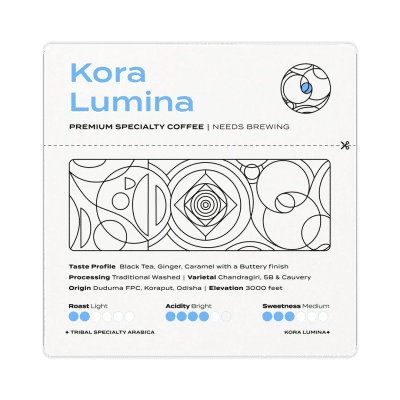
Caffinary (7 coffees) is Bangalore-based and holds multiple Koraput lots including Trousseau Adwaita (anaerobic, light-medium) and Kora Zinfandel (washed, medium). The wine-adjacent naming positions these coffees in a flavor-pairing context. Kaffenum (4 coffees) stocks anaerobic, washed, and natural lots — A1 Naturals, Hydro Naturals, Jangala Ra Dhana, and Pure Bliss — covering the range of available Koraput processing styles. Dream Hill Coffee (4 coffees) names its lots by harvest window (Autumn Bright, Spring Bloom, Summer Breeze washed and natural), suggesting direct-harvest sourcing rather than year-round stock. Kali (3 coffees) works at light-to-medium roast levels with honey, washed, and alternative-process lots.
Hill Groove Coffee (2 coffees) carries the most unusual process descriptions in the Koraput catalog: Madhu Agro Estate Black Honey (48-hour fermented, light-medium) and Madhu Agro Estate Sequentially Fermented Washed. Madhu Agro Estate is the first privately-named estate in the Koraput catalog, the beginning of an estate-level traceability tier above the TDCCOL baseline. The pattern mirrors Chikmagalur's specialty development: estate naming there preceded sub-regional recognition, which preceded price differentiation.
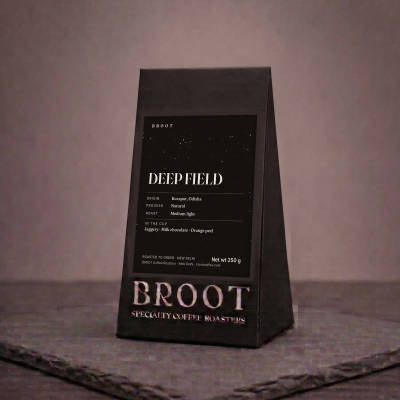
KOHI Roasters holds one coffee: TRIBE-O KORAPUT (anaerobic, light-medium). Pumpkin fermentation in tanks before extended raised-bed drying; notes of fruit, raisin, spice, chocolate, and sweet melon-like acidity. The Tribe-O Project was the first independently sourced specialty lot from the region, dating to 2021. Coffeeverse stocks Koraput Black Honey (honey process, light-medium). Black Poetry Coffee and Broot Coffee each hold one lot.
Koraput Coffees
The GI question: why Koraput is seeking its own tag
Koraput coffee currently qualifies under the Araku Valley Arabica Coffee GI tag, GI registration number 333, Coffee Board of India, March 2019. The Araku GI covers coffee from both Andhra Pradesh's Visakhapatnam district and the relevant growing areas of Odisha. At the time of registration, Koraput had no commercial identity, no branded output, and no grounds to seek independent recognition. The Araku GI was a practical solution that gave Koraput-grown coffee a legal origin claim without requiring its own infrastructure.
As the region develops commercially, the arrangement creates a structural problem. The Araku brand carries the accumulated investment of SAMTFMACS, the Paris café recognition, and the Rockefeller Foundation prize. Under the current arrangement, a Koraput coffee can carry an Araku Valley GI mark but gains none of Araku's brand equity, and the label misleads buyers about origin. Koraput and Araku are not interchangeable origins.
In 2023-24, the Koraput MP submitted a standalone GI application for the region. The path follows a precedent already set in Indian coffee: Bababudangiri in Karnataka pursued and received its own GI distinct from Chikmagalur because the sub-region's altitude profile and cup character warranted independent commercial recognition. Koraput is making the same argument across a state border.
For buyers: Until a standalone GI is issued, "Koraput coffee" on a label is a regional description, not a GI-certified claim. A roaster applying the Araku Valley GI mark to a Koraput-sourced coffee is technically compliant under the current registration, but the two names describe different terroirs and different production structures.
Reading a Koraput label
Process and roast level are the most reliable shortcut to what is in the cup.
Washed, medium roast is the baseline Koraput profile: chocolate, caramel, mild nuttiness, low acidity, medium body. Clean and straightforward. Works in South Indian filter, French press, or pour-over. Most TDCCOL-channeled coffees and Kruti's filter range fall here.
Washed, light or light-medium roast moves toward brighter character: citrus edges, cleaner finish, lighter body. Kruti's Koraput Light and Caffinary's washed lots represent this tier. More suitable for pour-over and Aeropress than filter methods designed for heavier extraction.
Natural, medium roast adds fruit character — plum, dark berry, brown sugar — while retaining the region's underlying body. Kindiriguda Naturals is the clearest reference.
Anaerobic, light-medium (primarily TRIBE-O and similar lots) departs furthest from the regional baseline: intense stone fruit, raisin, spice, sometimes a boozy aromatic. Best as a pour-over or Aeropress at lower extraction parameters, where the fermentation character can come through without being buried.
Sub-regional naming adds origin depth for buyers tracking sourcing specifics. Deomali indicates the highest-altitude zone in the catalog; washed lots from here tend toward a cleaner, more structured cup within the Koraput character. Kindiriguda indicates village-level natural process lots with the most consistent fruit expression available from the region. Madhu Agro Estate indicates private estate sourcing with fermentation-focused processing, the highest traceability tier currently in the catalog.
References
- Welcome to Odisha — Two Fine Cup Awards for Koraput Coffee at Flavour of India 2024
- Village Square — Why Odisha wants a GI tag for Koraput coffee
- The Print — Tribal Koraput becoming coffee hub
- 30 Stades — How Odisha tribals brew a global coffee brand (2021)
- 101 Reporters — Koraput's caffeine fix: Coffee cultivation mitigates distressed migration