


Chicory in Coffee: What It Does to Indian Filter Coffee
Most South Indian filter coffee powder is not all coffee. Roasted chicory root, usually 10 to 30 percent of the blend, dissolves far more readily than coffee, which is why a small share changes the colour, body and bitterness of the decoction. This guide explains what it does, what the ratios mean and how to read the label.

Most filter coffee powder sold in Tamil Nadu and Karnataka carries two numbers on the pack: one for coffee, one for chicory. 80:20 is the usual default. Chicory is the roasted root of a plant, not a kind of coffee, and it carries no caffeine. That second number shapes a cup of South Indian filter coffee more than most buyers assume. It sets how dark the decoction runs, how thick it feels, how bitter it tastes through milk, and how much caffeine reaches the tumbler.
The ratio works better as a recipe than as a purity score. Once you know what chicory does in the filter, 80:20, 70:30 and "100% coffee" look less like better and worse versions of one product and more like different drinks, each suited to a different way of taking coffee. This guide covers the mechanism, the common ratios, the labelling law, and what ICB's catalog shows about chicory blends on sale today.
What chicory is
Chicory (Cichorium intybus) is a blue-flowered plant in the daisy family. Its long taproot is dried, cut into cubes, roasted dark and ground. Raw chicory root is rich in inulin, a chain of fructose sugars. Roasting breaks most of that down: a 2016 study in the Journal of Agricultural and Food Chemistry found that inulin, sucrose and most amino acids largely degrade during roasting, while browning compounds such as 5-hydroxymethylfurfural form. What reaches the coffee shop is mostly caramelised sugar and roast compounds. It is dark, bitter-sweet, woody in aroma, and free of caffeine.
The coffee in an Indian filter blend comes from the Western Ghats. The chicory mostly does not. Uttar Pradesh and Gujarat together account for about 97% of India's chicory production, with Jamnagar, Kheda, Anand and Mehsana the main Gujarat districts and Etah and Aligarh in Uttar Pradesh. A packet of Kumbakonam-style powder is a blend of two agricultural regions more than 1,000 km apart.
Chicory contains no caffeine. An 80:20 blend has about a fifth less caffeine per spoon than the same coffee on its own. A 70:30 blend has about 30% less.
What chicory does to the decoction
Most of it comes down to solubility. Ground coffee is mostly insoluble: only around 30% of its dry weight can dissolve in water, and the rest is cellulose and other plant structure. Roasted chicory behaves very differently. In one pilot extraction study described in a US patent filing, chicory gave up about 76% of its dry weight as dissolved solids, against about 23% for coffee in the same stage. The two figures come from an industrial process rather than a home filter, so treat them as a rough guide, but the gap is wide. Gram for gram, chicory dissolves roughly three times more material than coffee.
This is why a small share has a large effect. On those figures, an 80:20 blend could draw close to half of everything dissolved in the decoction from the chicory, even though chicory is only a fifth of the powder. A spoon of chicory does more to the liquid than a spoon of coffee. So going from 80:20 to 90:10 changes the decoction more than swapping one dark-roast coffee for another.
It shows up in the cup in three ways.
Colour. Chicory's browning compounds turn the decoction near-black, darker than the same coffee would brew alone.
Body. The dissolved sugars and roast compounds make the decoction feel thicker. When home brewers say filter coffee "tastes watery without chicory", this is what they are describing.
Bitterness. Chicory adds its own bitterness, woody and close to burnt caramel, which is different from coffee's. It holds up through three or four parts hot milk and a spoon of sugar, which is why a chicory decoction still reads as "strong" in a milky cup.
Chicory brings no caffeine, no acidity and no origin flavour. It also narrows the differences between coffees: two different estates blended at 80:20 taste more alike than they would on their own. That suits a filter brand that wants every packet to taste the same. It works against a single-origin.
Refractometers calibrated for coffee give misleading readings on coffee-chicory brews, and researchers have proposed a separate gravimetric method for measuring dissolved solids in these mixtures. By that measure too, it is a different liquid from a coffee-only decoction.
Chicory bitterness extracts quickly in very hot water. Pouring at 91–93°C instead of straight off the boil keeps it in check. Without a thermometer, rest a just-boiled kettle for about 90 seconds at sea level. The full method is in the guide to brewing South Indian filter coffee.
Why Indian filter coffee uses chicory
Chicory as a coffee stretcher started in Europe. It spread in France during Napoleon's Continental System from 1806, when imported coffee became scarce, and the habit lasted after supplies returned. It later took hold in New Orleans, where coffee with chicory is still a local tradition.
In South India, accounts of how chicory arrived are less settled. A 2023 report in South First, quoting coffee grower Yesaloor Udayakumar, dates large-scale chicory mixing in Karnataka to 1977, when coffee powder prices were very high and the Coffee Board accepted a 10–20% mix. Other stories credit colonial "Camp Coffee", French Puducherry or wartime rationing. They are repeated widely, but the sourcing behind them is thin.
The economics are easier to pin down. Chicory costs less than coffee and dissolves more, so a packet makes more cups. The owner of a Karnataka filter coffee brand that has been trading for more than seven decades told South First that customers expect a packet to last four or five days, and that only about 2% of his buyers choose powder without chicory. Some ask for 40%. Restaurant owners in the same report said chicory helps them hold cup prices. If that estimate is close, chicory-free powder is a small minority choice in filter coffee's home market. A specialty-weighted catalog such as ICB's looks the other way round.
Not everyone accepts the blend. In 2023, growers from Chikkamagaluru, Hassan and Kodagu asked the Coffee Board to ban chicory mixing, arguing that it cuts demand for coffee. According to the growers, the Board said it had no authority to do so and referred the matter to FSSAI. The growers also made health claims against chicory that the report does not substantiate.
The South Indian filter is a brewing device, and it works with or without chicory. Chicory is a choice about what goes into the blend, not part of the method.
Coffee to chicory ratios: 90:10, 80:20, 70:30 and pure
The ratio on the pack is the most useful single number for predicting the cup. These are the ranges most commonly sold in India, and the kind of serve each tends to suit.
Coffee to chicory ratios and what they produce
| Ratio (coffee:chicory) | Cup character | Tends to suit |
|---|---|---|
| 100:0 (pure coffee) | Lightest colour, thinnest body, most origin flavour | Black coffee, light milk, single-origins |
| 90:10 | Slightly darker and fuller; origin flavour still readable | Less milk, medium roasts |
| 80:20 | Dark, thick, bittersweet; the Madras-style default | Three to four parts milk with sugar |
| 70:30 | Very dark and heavy, more chicory bitterness, about 30% less caffeine | Strong, milky, sweet kaapi |
| Above 70:30 | Mostly a cost lever; the legal limit is 51:49 | Price-driven blends |
Home brewers comparing notes on forums such as Team-BHP tend to settle between 15% and 20% chicory. Most reference descriptions of filter coffee give 10–20%. The 80:20 default sits at the top of that range, which suits a decoction meant to be diluted heavily with milk.
To blend your own, buy roasted chicory powder separately. Start at 10% by weight (2 g in a 20 g dose) and raise it 5% at a time, keeping the total dose the same so each cup is a fair comparison. Ground chicory is fine and slightly sticky, so high ratios drain more slowly through the filter's upper chamber. If the drip stalls, press the plunger disc down more lightly or lower the ratio.
Chicory blends are built for milk. Drunk black, an 80:20 decoction tends to taste woody and harsh. For black filter coffee, 90:10 or no chicory works better.
How to read the label
Indian food law sets a ceiling on chicory. Under the Food Safety and Standards regulations, a product sold as a "coffee-chicory mixture" must be at least 51% coffee by weight, so chicory can be at most 49%. Both percentages must be declared on the pack. The word "pure" may describe only a single-ingredient food, so a blend cannot be sold as pure coffee.
Enforcement has tightened over the past few years. FSSAI issued a compliance advisory on coffee-chicory labelling in November 2021, and a 2022 check of 42 centrally licensed businesses found 29 of them non-compliant. An amendment notified on 8 August 2025 requires the declaration "COFFEE …%, CHICORY …%" on the front of the pack. After industry objections, mainly about fitting a mandatory box onto small packets, the boxed format has been put on hold, a plain text declaration is allowed in the meantime, and the compliance deadline has moved to 1 July 2027. Planters continue to press for a 70% coffee minimum, so the rules may change again.
If a filter powder names no ratio and does not say "100% coffee", check the back panel for the words "coffee-chicory mixture". Strength names such as Mild, Strong or Extreme Strong describe the cup, often through roast and chicory share together. They do not describe caffeine.
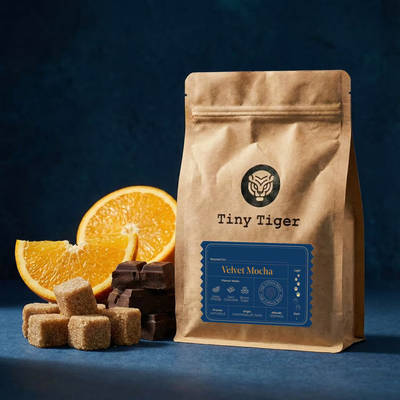
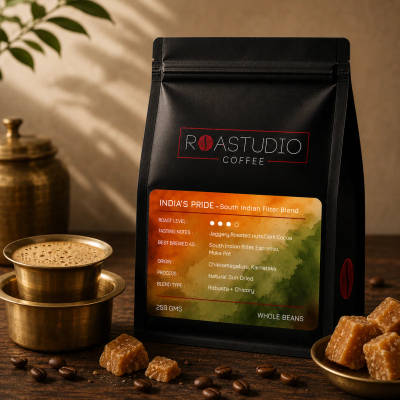
Chicory blends on ICB
As of October 2026, ICB lists 37 in-stock chicory blends from 23 roasters. That is about 2.4% of the 1,515 coffees in stock. They are dark: 24 dark roasts, 7 medium-dark and 6 medium, with no light roasts. That fits the mechanism. Chicory's bitterness and body are made to sit with dark coffee and milk, and a light roast has little to gain from them. Of the 37, 24 are tagged for the South Indian filter. A handful are also tagged for moka pot and French press, and one is a New Orleans-style cold brew blend.
Ratio disclosure is patchy. Only 7 of the 37 put the ratio in the product name. Seven Beans lists Urubage at 80:20 and Agumbe at 70:30, Karma Kaapi's Desi Magic is 80/20, Devan's Natraj is 70:30, Bean By Nation's Indian Intense is 80:20, and Camrose Organics sells an 80D and a 70D. Others signal strength through a naming ladder, such as Hunkal Estate's Mild, Rich, Strong and Bold, and leave the ratio to the back of the pack. Only 10 of the 37 list flavour notes at all. Soil, caramel and chocolate appear most often. The ratio predicts the cup better than any other number on the pack, and on most of these products the buyer has to go looking for it.
Chicory blends are also the lowest-priced category in the catalog. The median price is ₹305 for arabica-chicory blends and ₹412 for other chicory blends, against ₹750 for straight arabica. ICB's filter shelf as a whole looks different. Of 192 in-stock coffees tagged for the South Indian filter, only 24 contain chicory. That reflects a catalog weighted towards specialty roasters, not the wider market, where chicory blends are the norm. The full list is on the chicory blends page.
Chicory blends on ICB



Chicory and specialty coffee
Chicory is not coffee, so a coffee-chicory blend cannot be cupped for a specialty score under the Specialty Coffee Association's system. It sits in its own category. A specialty cupping score and a Mylapore tumbler are measuring different things.
The two now often share a shelf. Several roasters that sell traceable single-origins also sell a chicory blend with a declared ratio, among them Seven Beans, Black Baza (Whistling Schoolboy), CO.PHI (Bodhisattva) and Vui (Madras Blend). They print the ratio as part of the recipe. Among the roasters ICB tracks, chicory seems to be shifting from an unstated cost saving to a declared part of the recipe. The 2025 labelling amendment pushes the wider market the same way.
For a specialty single-origin brewed in the filter, 10% chicory or none keeps the origin flavour readable. Medium to medium-dark roasts behave most predictably over the filter's long contact time. Adding chicory to a light-roast, fruit-forward lot mostly covers up what made it worth buying.
References
- Journal of Agricultural and Food Chemistry (2016) — chemical changes in chicory during roasting, DOI 10.1021/acs.jafc.6b02423
- US Patent 5958497 — chicory extract production processes (extraction yields of chicory and coffee)
- US Patent 4158067 — coffee extraction (soluble fraction of ground coffee)
- ChemRxiv — gravimetric method for total dissolved solids in coffee-chicory mixtures
- FSSAI — compliance letter on labelling of coffee-chicory mixtures, November 2021
- FSSAI — press release on coffee-chicory labelling compliance, March 2022
- FSS (Labelling and Display) First Amendment Regulations 2025 — coffee-chicory mixture direction
- South First — "Do you like your coffee with chicory? Coffee Board is considering a ban on this mixture" (March 2023)