


Wayanad Coffee: Regional Characteristics
Kerala's Wayanad district is one of India's largest coffee regions by area, yet the specialty market has barely engaged with it. It grows two distinct crops for two completely different markets: a GI-tagged Robusta at scale, and a specialty arabica tier slowly emerging at higher elevations.

Wayanad covers more than 67,000 hectares of coffee cultivation (Coffee Board of India) in northeastern Kerala, supports approximately 68,000 farmers, and accounts for 90% of the state's total coffee output. A 2024 NRSC satellite-mapping estimate (Coffee Board & ISRO's Coffee Plantation Atlas of India) puts cultivated area at 52,762 hectares — a different measurement method, not a revision of the figure above. In area, it is comparable to Coorg. In ICB's catalog, it holds 10 entries, none of them rated.
That gap is the starting point for understanding Wayanad. The region is not absent from Indian coffee — it is absent from the specialty segment of it, and for structural reasons, not qualitative ones. A GI-tagged Robusta from Wayanad cleared a cup score above 80 at the World Coffee Conference in Copenhagen. The catalog count is a market fact, not a quality verdict.
The scale of that gap isn't immediately obvious. Chikmagalur, which covers a comparable production area, holds approximately 390 entries in ICB's catalog. The difference is almost entirely explained by species: Chikmagalur is arabica-dominant, Wayanad is Robusta-dominant, and the specialty market has not yet built a consumer vocabulary for Robusta at origin.
Where Wayanad sits
Wayanad occupies the northeastern corner of Kerala, bordered by Karnataka's Mysuru and Kodagu districts to the north and east, and Kerala's Kozhikode and Malappuram districts to the west. It sits within the Western Ghats, the same mountain system that runs through Karnataka's coffee belt.
Elevation across the district ranges from roughly 700 metres in the lowland zones to over 2,100 metres in the reserve forests. Active coffee cultivation concentrates between 700m and 900m, where most of the Robusta crop grows. A smaller arabica zone occupies upper-elevation slopes above 900m, where temperatures drop enough for arabica cherry to develop more slowly.
Two monsoon cycles shape the climate. The southwest monsoon arrives in June and runs through September; the northeast monsoon follows in October through December. Harvest begins in December and runs through February, meaning the district emerges from months of consecutive rainfall just as picking starts. Residual humidity persists through the dry window, particularly at lower elevations. The Coffee Board of India puts Wayanad's annual rainfall at 1,100–1,200mm.
Coffee area in Wayanad represents 33.65% of the district's total cropped area. Coffee is not one of several crops here; it is the crop. The monsoon calendar leaves a narrow window for outdoor drying, and that constraint shapes nearly everything about how coffee is processed.
For more on how geography shapes flavor across India's coffee regions, the four-lever framework covering elevation, shade, soil, and rainfall applies directly to Wayanad's profile.
Two species, two markets
Robusta (Coffea canephora) covers roughly 95% of Wayanad's coffee area. It is the defining crop of the district, not a secondary one.
This was not always the case. The British East India Company introduced coffee to Wayanad in the early 19th century. By 1841, large-scale plantations were established, and by 1869 roughly half of South India's arabica cultivation was concentrated in Wayanad. Coffee leaf rust (Hemileia vastatrix) then devastated the arabica crops in the second half of the 1800s. Robusta, which resists the disease, was introduced as a replacement. The current species distribution is the outcome of a 19th-century plant pathogen, not a deliberate agricultural choice.
Robusta grows across the lower elevation belt, where higher temperatures and the district's acidic red laterite soils suit Canephora better than Arabica. The variety covers over 67,000 hectares; annual output exceeds 67,000 tonnes. Heat tolerance and disease resistance are the practical advantages at these elevations.
Arabica occupies the upper-elevation plots, broadly above 900m on Wayanad's western slopes. Varieties present in the specialty catalog include S795, Cauvery (a Catimor-lineage hybrid), Kent, Chandragiri, and TR9 (a CCRI-developed Robusta hybrid appearing in some specialty lots). Cooler conditions at these elevations allow arabica cherry to develop more slowly, building modest complexity. Wayanad arabica is lower in acidity and fuller in body than comparable Karnataka arabica because its elevation ceiling is lower than that of Chikmagalur or Bababudangiri.
The market split follows the species split. Wayanad Robusta feeds commodity blending, instant coffee manufacturing, and the traditional South Indian filter market. The arabica tier is where specialty market interest has tentatively appeared: five roasters in ICB's catalog, lots described with notes of dark chocolate, spice, grape, and tobacco at medium-dark roast levels.
In 2019, the Ministry of Commerce and Industry granted Wayanad Robusta Coffee a Geographical Indication (GI) status, one of five Indian coffees in that batch. The GI certifies geographic origin within Wayanad district and compliance with Coffee Board quality parameters. It does not certify processing method, roast level, or organic status. The certified cup profile is softish to neutral, full-bodied, with intense aroma and a hint of chocolate. At the World Coffee Conference in Copenhagen, GI-quality Wayanad Robusta logged a cup score above 80, the threshold for specialty grade in Robusta evaluation.
Why processing diversity is limited
Buyers accustomed to the processing range visible in Chikmagalur — naturals, honeys, and anaerobic experimentals — will find less variety in Wayanad. Washed processing has been the district's default for decades. The reason is climatic.
Natural processing requires 2–6 weeks of consistent, low-humidity sun-drying. Coffee cherries left out during Wayanad's monsoon months, or in the residual humidity that follows, face meaningful mould risk. Most farms at lower elevations lack covered raised-bed drying infrastructure. Washed processing is, under those conditions, a risk management decision: remove the fruit pulp quickly, ferment the parchment in water, dry a more stable product.
The ICB catalog data looks counterintuitive here. Of the 4 pure-Wayanad coffees listed, 3 are natural-processed and 1 is categorised as "other." This reflects selection bias, not regional norms. The roasters sourcing single-origin Wayanad — primarily Black Baza Coffee and Caffinary — appear to be selecting experimental lots from farms that have the infrastructure to manage natural processing. The catalog represents the specialty-tier exception. Across the district's 67,000 hectares, washed is still the standard.
A buyer looking at the catalog and concluding that Wayanad is "a natural-processing region" is reading a curated sample.
What Wayanad coffee tastes like
Robusta
The quality profile for GI-certified Wayanad Robusta, established through Coffee Board of India tasting protocols and verified at the World Coffee Conference, describes the cup as softish to neutral, full-bodied, with a remarkably intense aroma and a subtle hint of chocolate. Commodity-grade Robusta often exhibits harsh, pyrazine-driven bitterness; Wayanad's shade-grown cultivation under spice-farm canopy (pepper, areca nut, banana) moderates that character. The crema-enhancing properties make it a common component in espresso blending. International manufacturers including Nescafé source Wayanad Robusta for blend applications.
Specialty Robusta is a real category, and the 80+ cup score at Copenhagen confirms Wayanad's GI-quality production sits within it.
Arabica
Four pure-Wayanad coffees in ICB's catalog, none rated — the picture that emerges from this data is directional at best.
The catalog shows a consistent cluster across those four entries: Dark Chocolate and Spice appear in 2 of the 4 coffees. Tobacco and Grape appear in 2 of 4. Berry (Fresh), Plum, Caramel, and Honey each appear once. All four are roasted at medium-dark or dark. Black Baza Coffee's Wayanad lots — the most documented in the specialty segment — describe Almond, Cacao Nibs, Dried Berries, and Toast.
Lower-elevation arabica tends toward dense body, muted acidity, and spice notes that reflect polyculture farming (coffee grown under pepper, cardamom, and areca nut shade). That's what these notes point to. The fruit-forward brightness of Karnataka's higher-elevation arabica — Bababudangiri at roughly 1,340m, the upper Attikan lots at 1,219–1,676m — is absent at Wayanad's arabica zone. The difference is the altitude ceiling, not processing choices or roaster decisions.
Zero ratings across all 10 catalog entries is not incidental. Buyers who have purchased Wayanad specialty lots have not returned to ICB to record the experience, a pattern pointing to low repeat-purchase and community engagement with this origin, not low quality. For comparison, Araku Valley's 18 catalog entries have 2 rated coffees; Wayanad's 10 entries have none.
Who grows Wayanad coffee
Approximately 68,000 farmers cultivate coffee across Wayanad district. Over 80% work on plots smaller than one hectare. Coffee farming represents roughly 25% of the district's total population; it is the economic backbone of the region.
That smallholder structure is the direct reason specialty traceability is thin. A buyer wanting an estate-specific, single-lot arabica from a named farm has few options. Most production flows into cooperative or intermediary aggregation chains that produce commodity Robusta blends for domestic and export markets. The same fragmentation that makes Wayanad's total Robusta output enormous makes single-estate arabica sourcing structurally difficult.
Wayanad hosts one of India's larger concentrations of tribal (Adivasi) communities (Paniya, Kuruma, Kurichiya, and Kattunaicka groups among them). Many tribal smallholders participate in coffee farming as a primary livelihood. This has not been formally mapped in the specialty context the way Araku Valley's SAMTFMACS cooperative model has been. There is no equivalent Wayanad cooperative with consumer-facing recognition in specialty channels.
The Kerala government's Climate Smart Coffee Project specifically targets marginal, tribal, and women farmers for cluster formation and group certification. Whether that produces traceable specialty lots at commercial scale is not yet established.
The cooperative structure that made Araku Valley traceable in specialty channels (SAMTFMACS spent decades building that institutional infrastructure) has no equivalent in Wayanad. A government programme targeting cluster formation and certification is a different thing from a cooperative with procurement guarantees and consumer-facing branding. The gap between the two is where Wayanad's tribal smallholder story currently sits.
Wayanad in the specialty market
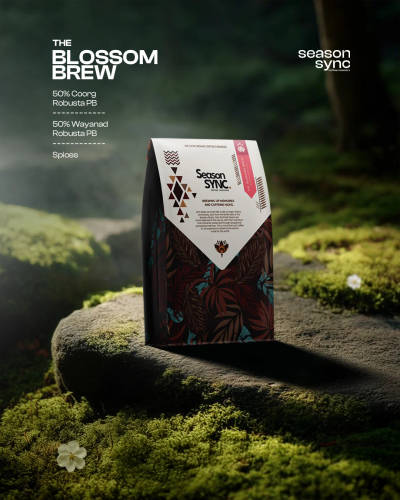
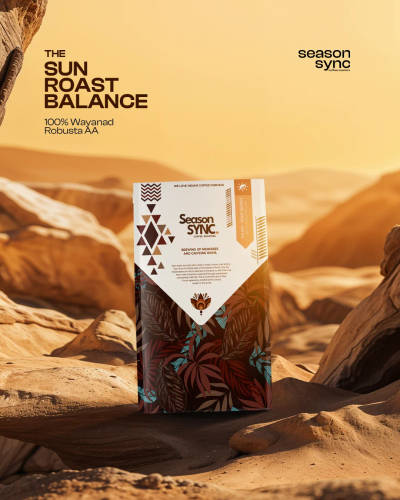
Five roasters currently list Wayanad in ICB's catalog: Black Baza Coffee (3 entries), Caffinary (4 entries, several of which are multi-region blends), Bloom Coffee Roasters, Coffee Ideas, and Kali (1 each).
Black Baza Coffee has the most documented Wayanad sourcing posture. They are a Fair Trade conservation enterprise whose sourcing explicitly links to wildlife corridor preservation in the Western Ghats. Their Wayanad lots (Ficus, Luna, Whistling Schoolboy) blend arabica and Robusta and are positioned around ecological sourcing rather than terroir complexity. Flavor descriptors across their Wayanad range (Almond, Cacao Nibs, Dried Berries, Toast, Dark Chocolate, Spice, Tobacco) are consistent.
Caffinary sources TR9, a CCRI Robusta hybrid, from Wayanad for several blend and single-origin offerings positioned around energy and function rather than origin character.
Wayanad Coffees

The developing story
Three institutional investments are active in Wayanad, each targeting a different part of the value chain.
The most concrete is the Carbon Neutral Coffee Park near Kalpetta, a 20-acre centralised processing facility funded by the Kerala Infrastructure Investment Fund Board and operated by Kerala Coffee Limited. It is designed as an aggregation hub for smallholder Robusta, targeting Coffee Board quality certification and EU sustainability standards. Land acquisition is complete; construction timelines are not confirmed in public documentation.
A second initiative, the Climate Smart Coffee Project, puts ₹3 crore from the Kerala government toward marginal, tribal, and women farmers, organising them into clusters that can qualify for group certification and shared processing access. The programme targets premium market positioning through value-added products including cold brews.
The third is national: in 2025, Wayanad Robusta Coffee received a Special Mention under Category A – Agriculture at the Government of India's One District One Product meet — the first such recognition for any product from Kerala. It places Wayanad in the same programme as Araku Valley Coffee, which holds ODOP backing in Andhra Pradesh.
These initiatives primarily target Robusta premium market development: better pricing for GI-quality Robusta, sustainability certification, and processing infrastructure for the existing commodity output. The specialty arabica story in Wayanad depends on factors they do not address: altitude ceiling, monsoon processing constraints, and consumer recognition of Wayanad as a distinct arabica origin. The two tracks may converge or remain structurally separate.
For convergence to happen, one of two things would need to change: arabica specialty development would need to build a market case on Wayanad's existing elevation range (real but not comparable to Karnataka's upper zones), or specialty Robusta would need to find consumer traction as an origin category independent of the arabica-centred specialty vocabulary. The ODOP recognition and GI infrastructure point toward the second path.
What to expect if you encounter Wayanad coffee
Most Wayanad coffee in the specialty market will be medium-dark to dark roasted, arabica or an arabica-Robusta blend, with descriptors in the chocolate, spice, tobacco, and grape range. Fruit-forward complexity of the kind found in high-elevation Karnataka lots is not a characteristic of this region.
Washed arabica from Wayanad will be clean and chocolate-leaning. The handful of natural lots that reach specialty channels will show dried fruit and grape notes; the brightness of Araku or Bababudangiri naturals is not a typical characteristic at Wayanad's elevation. Robusta blends will be full-bodied, low-acid, and dense, suited to espresso, South Indian filter, or any preparation where body and crema are the priority.
Estate traceability is available primarily through Black Baza Coffee's conservation-linked lots. Single-estate Wayanad arabica of the kind documented in Coorg or Chikmagalur is not currently in the specialty market. None of the Wayanad entries in ICB's catalog are rated.
References
- Wayanad District — Wayanad Robusta Coffee
- Kerala Industries — ODOP Product Description: Wayanad Coffee
- Press Information Bureau — GI Certification for Five Varieties of Indian Coffee (2019)
- GI Kerala — Wayanad Robusta Coffee
- The South First — Wayanad Robusta Coffee: From Colonial Roots to Global Recognition
- The South First — Kerala All Set to Make Wayanad Coffee World-Class
- OnManorama — Wayanad Robusta Coffee Earns National ODOP Recognition (2025)
- Coffee Board of India — Statistics