


Baba Budangiri Coffee: Regional Characteristics and What the Label Actually Tells You
Bababudangiri is a highland sub-range inside Chikmagalur district, Karnataka, at 1,000–1,500 m MSL, where Indian coffee cultivation is traditionally dated to the 17th century. The sub-region carries a 2019 GI tag and a reputation as the country's original coffee origin. ICB's directory lists 121 coffees under this label — spanning balanced washed arabica, tropical-fruit anaerobic lots, and complex fermented naturals. The label signals estate-level traceability. It does not describe a single cup profile.

What Bababudangiri is
The name appears on specialty bags as a provenance upgrade — a signal that the coffee comes from somewhere more specific and historically significant than "Chikmagalur." That framing is geographically accurate. It does not capture how much the label varies in practice.
Bababudangiri is a mountain sub-range inside Chikmagalur district, Karnataka — not a separate growing region but a named area within the district's boundaries, running through Hassan district as well. The distinction from the broader Chikmagalur label comes down to elevation and traceability. The Coffee Board treats Chikmagalur (700–1,200 m MSL) and the Bababudangiris (1,000–1,500 m) as separate regions, and the Bababudangiri range extends above the main Chikmagalur belt. Above approximately 1,200 m in the Western Ghats, arabica tends to show brighter acidity and more defined aromatics. Cooler temperatures slow cherry ripening, which allows more time for sugar and acid development. Harvest in the Bababudangiris runs December–February, on the black soil the NRSC/Coffee Board plantation atlas (2024) maps around the Baba Budangiri hills, against the red soil found further south in the taluk.
The sub-range lies near Mullayanagiri, Karnataka's highest peak at roughly 1,930 m, but that upper terrain does not support coffee cultivation. Bababudangiri's productive zone sits below it.
For a full analysis of Chikmagalur district's flavor patterns, roaster concentration, and processing mix, see Understanding Chikmagalur Coffee: Regional Characteristics and Flavor Patterns. This article focuses on what distinguishes the sub-range.
On spelling: the sub-range appears under multiple forms — Bababudangiri, Baba Budan Giri, Baba Budangiri, Bababudangiris. The Coffee Board and GI Registry use "Bababudangiris"; Indian specialty roasters use various versions. All refer to the same place.
The origin story
The sub-range takes its name from Baba Budan, a 17th-century Sufi saint whose hermitage was in these hills. The legend records that he returned from hajj around 1670 via the Yemeni port of Mocha carrying seven raw coffee seeds, reportedly hidden on his person. He planted them at his hermitage, and the hills were named after him.
Seven was significant in Islamic tradition, which may be why the specific number survived in the telling. The more consequential detail is that he carried raw viable seeds rather than roasted or dried beans — the form Yemen typically exported. Arab traders maintained their control of the global coffee trade by ensuring no fertile seeds left the region. Baba Budan's seeds broke that arrangement and brought the first cultivable coffee plants to the Indian subcontinent.
Historical documentation for this event is thin. This is well-established lore, cited consistently across colonial records, regional accounts, and contemporary sources, but no firsthand accounts, precise dates, or administrative records survive to verify it. The tradition carries cultural and religious weight: the dargah (Sufi shrine) at Bababudangiri is an active pilgrimage site, and the story shapes how Karnataka's coffee industry describes its own origins.
What the GI tag means
In 2019, Bababudangiri Arabica received a Geographical Indication designation — India's 355th GI product, awarded alongside Coorg Arabica, Araku Valley Arabica, Wayanad Robusta, and Monsooned Malabar in the same batch.
A GI designation is a protected origin name. It establishes that coffee labeled Bababudangiri Arabica was grown in this geographic area. Processing standards, minimum quality scores, shade requirements, and production practices fall outside its scope. A commodity-grade washed lot from a large estate and a micro-fermented anaerobic natural from a small producer both qualify, provided the coffee was grown in the sub-range.
GI as geographic marker, not quality tier: This applies to all five Indian coffee GIs from 2019. None impose production standards or quality minimums. The designation confirms where the coffee was grown, not how, or to what standard.
What the ICB catalog shows
ICB's directory carries 121 coffees tagged to Bababudangiri and its name variants, across approximately 30 region-label variations used by different roasters. Of these, 114 are currently in stock.
Roast levels skew toward medium-dark (36 coffees), with light-medium (26) and light (25) close behind, followed by dark (16) and medium (13). The medium-dark weight is largely Baarbara Coffee's filter-roast catalog, which accounts for a large share of the labeled output.
The processing picture is more telling:
Fifty of 121 coffees carry no clear process label — a data gap, not an absence of processing. That proportion (nearly 40% of catalog entries without a process label) suggests a large share of the sub-region's output is marketed on origin name and roast level rather than process differentiation, even as specialty buyers increasingly use processing as the primary flavor predictor. Among those with labeled processing, experimental-family lots (26 experimental, 3 anaerobic, 3 double-fermented) slightly outnumber conventional-process lots (16 washed, 9 natural, 6 honey). The GI description of Bababudangiri as a washed arabica origin captures its historical and export-trade identity; that distribution would look unfamiliar to buyers who know this origin as India AA Bababudangiri.
Cup profiles by processing method
On a Bababudangiri bag, processing and roast level predict the cup character more reliably than the origin label. The same altitude produces meaningfully different results depending on what happens after harvest. The role of processing in cup character applies here as clearly as anywhere in India.
Washed and standard lots. The profile the GI description and export trade point to: balanced, medium-bodied, with chocolate and nut notes and gentle citrus in the finish. DRWakefield, which has sourced India AA Bababudangiri through Allanasons for over two decades, describes it as full-bodied, intense chocolate and caramel, low acidity. ICB's washed-labeled coffees from the sub-range show citrus, spice, black tea, butter, and malt as the most common notes. SLN 795, documented across 24 of the labeled Bababudangiri coffees with variety data, has a structured, body-forward character: chocolate, nuts, dried fruit. This is the cup that export buyers know and that roasters running filter-coffee blends typically source.
Natural and honey lots. A smaller group (9 natural, 6 honey in the labeled set), sitting between the washed baseline and the experimental range. Natural Bababudangiri coffees in the catalog lead with citrus, apple, guava, prunes, and orange. Honey lots show apple, floral, and honey notes. More fruit-forward than washed, without the intensity of full fermentation.
Experimental, anaerobic, and fermented lots. The largest labeled category (26 experimental, 3 anaerobic, 3 double-fermented). These produce intensely fruity, ferment-influenced cups. Across the full Bababudangiri catalog, the most common notes are fruity (19 coffees), floral (10), citrus (9), prunes (8), and berry (8). Ratnagiri Estate's "Culture Naturals" series, which produces rose, litchi, and melon notes in ICB's catalog, is a clear example of what this tier looks like from a named estate. At this end of the range, processing is the dominant flavor variable; the altitude and terroir contribute but do not define the cup.
Reading a Bababudangiri bag: Check processing first, then roast level. Washed + medium or medium-dark → expect the balanced chocolate-citrus profile. Experimental or anaerobic → expect fruit-forward, ferment-influenced character. Natural + light roast → fruit and sweetness without ferment intensity.
The estates that define the sub-region
Baarbara Coffee accounts for 71 of 121 Bababudangiri-tagged coffees — about 59% of the sub-region's listed output in ICB's directory. Naivo Coffee (8), Gandhi's Coffee (7), El Bueno Coffee (6), and Coffeeverse (5) follow. That concentration is more pronounced than in any other Indian sub-region in the directory. What buyers encounter when they search for Bababudangiri coffee is largely shaped by one estate-roaster's processing and roast decisions, not by the sub-region's general production character.
Baarbara Estate was founded in 1896 and is both a growing estate and a roasting brand — the same operation grows, processes, and sells. The estate sits at 3,850–5,350 ft (approximately 1,173–1,630 m), shade-grown under jackfruit, jamun, strangler fig, silver oak, wild fig, rosewood, and red cedar, with black pepper and other spice crops intercropped. Coffee is hand-picked and hand-sorted. Its 71 catalogued coffees span washed filter standards through 21 experimental lots. Running both the farm and the roastery means the same terroir can be put through multiple processing experiments without coordinating with an outside buyer.
Ratnagiri Estate has been in the Patre family since 1927 and is Rainforest Alliance certified. The estate sits at approximately 1,250–1,450 m and is sourced by several roasters — Blue Tokai, Naivo, El Bueno, and others. Processing experiments include double-washed, honey, anaerobic, and culture-naturals fermentations, each sold as a distinct lot. In ICB's catalog, Ratnagiri lots show apple and floral notes from honey processing through litchi, melon, and rose from the anaerobic culture naturals.
Kalledevarapura Estate has 4 coffees in the directory, all through Bili Hu and all experimental (anaerobic, washed-natural, honey), with apricot, mango, tamarind, and almond in the flavor data. Other estates appearing in the catalog include Gundikhan (3 coffees), Riverdale (2), Malleshwara, Bettadakhan, and Krishnagiri, all with limited sourcing data.
For context on what Indian coffee estates do between cherry and parchment, from selective picking through wet milling and drying, the estate explainer covers the process in full.
What a Bababudangiri label tells a buyer
When a roaster uses "Bababudangiri" rather than "Chikmagalur," two things are generally implied: the coffee comes from the upper-elevation sub-range of the district (1,000–1,500 m rather than the lower zones), and the sourcing is estate-level rather than aggregated district procurement. Both are meaningful provenance signals.
The label does not convey cup profile. Without the processing method and roast level, a buyer reading "Bababudangiri Arabica" cannot predict what the cup will taste like. The range is too wide. Variety, processing, and roast are the reliable predictors — origin identifies the geographic source and elevation band, but does not substitute for the other information on the bag.
Baba Budangiri Coffees
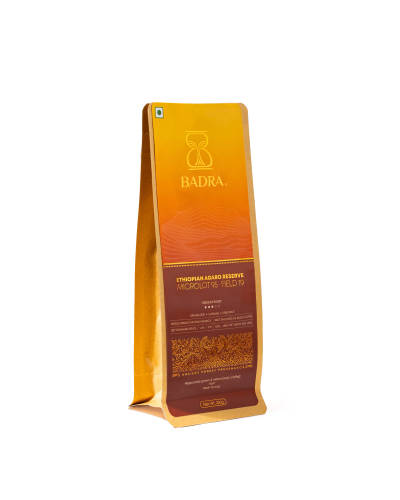

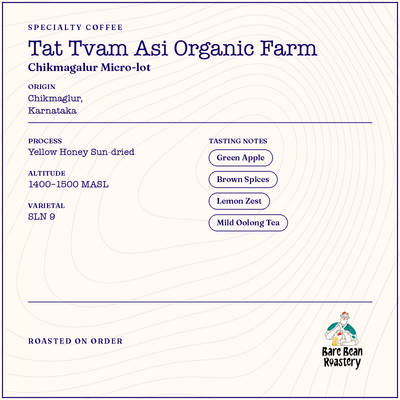
How Bababudangiri sits in Indian specialty
Bababudangiri sits inside India's largest specialty-coffee producing district. Its primary differentiator within Chikmagalur is elevation: the 1,000–1,500 m range concentrates the district's high-altitude arabica into one named area. The sub-region's principal estates (Baarbara at 1,173–1,630 m, Ratnagiri at 1,250–1,450 m) sit near the practical ceiling for Indian arabica cultivation.
The Western Ghats is a global biodiversity hotspot. Karnataka coffee agroforests support 204 bird species, including 13 found only in the Western Ghats, according to research from the Centre for Wildlife Studies. Studies have found that these farms can support forest corridor restoration when shade canopy is maintained. The three-layer canopy (native trees, coffee plants, and intercropped spices) is standard practice across Bababudangiri estates, not a differentiator unique to any producer.
Specialty roasters have started using more granular sub-range labels — Joldal Palya, Kaimara Belt — following the same logic that moved labeling from "Chikmagalur" to "Bababudangiri" in the first place. Finer provenance claims tend to track more direct sourcing relationships, which is the pattern across Indian specialty generally. Those finer labels will face the same predictive limit as "Bababudangiri" unless they arrive paired with process and variety data — geography narrows the field, but the cup still depends on what happens after harvest.