


Understanding Indian Coffee Estates (And Why They Matter)
When a specialty coffee bag lists "Ratnagiri Estate" or "Baarbara Estate", it is making a traceability claim — not just naming a place. This article explains what an Indian coffee estate is operationally, how it produces coffee from cherry to dispatch, and which estates appear most widely across Indian specialty roasters.

Estate names appear on Indian specialty coffee bags regularly — Ratnagiri, Baarbara, Attikan, Harley, Riverdale — but the term itself is rarely explained. Most buyers encounter the name and assume it signals something about quality or exclusivity without a clear framework for what it actually represents.
A coffee estate is a specific, named agricultural unit. The ICB catalog currently tracks 134 distinct estate names across coffees from over 60 roasters. That number reflects how widely estates have become the primary unit of origin identity in Indian specialty coffee. Estate attribution exists for only 41% of the 921 coffees in ICB's catalog; the remaining 59% carry region-only or no origin detail. That proportion is not a gap in the data. It reflects the structure of Indian production, where most volume trades without farm-level traceability.
What a coffee estate is (and isn't)
An estate is a single, owned or family-managed agricultural unit — typically 20 to 500+ hectares — that produces coffee and controls at least part of its own processing. An estate has the processing infrastructure to maintain its lot's identity from cherry harvest through to the green coffee it delivers to a roaster.
Smallholder farms work differently. India has roughly 250,000 coffee growers, and 98% of them are small growers by holding size. Most smallholders sell their harvested cherry to a wet mill or cooperative, where it is processed and often combined with cherry from other farms. At that point, the individual farm's identity is lost — the lot becomes a regional or cooperative-grade product. Volume-wise, smallholder production dominates Indian coffee output. But specialty coffee catalog representation skews heavily toward named estates precisely because traceability requires infrastructure, and most smallholders do not have curing facilities. For buyers, this means the specialty coffee they encounter — the named, estate-attributed bags on roaster websites — represents a small fraction of India's actual production volume. The catalog is a curated window, not a full cross-section of the crop.
Traceability hierarchy in Indian specialty coffee, least to most specific:
Region → Cooperative lot → Estate → Micro-lot (block within an estate)
When a bag says "Chikmagalur", the coffee could originate from any farm in the region. When it says "Ratnagiri Estate", it identifies a specific 45-hectare farm in the Sahyadri range with a documented owner, altitude band, and processing setup. Micro-lots go further still — identifying a specific block or processing batch within one estate.
The terms "single origin" and "single estate" are sometimes used interchangeably; they are not the same. Single origin is a broad category: any coffee traceable to a defined origin, whether that origin is a region, a cooperative, or a specific farm. Single estate is the subcategory where that origin is one farm. Estate coffee is a subset of single origin, not a synonym for it.
Estate naming in Indian specialty coffee is also a relatively recent development. Before the liberalization reforms of 1994–96, the Coffee Board of India managed a pooling system — all production flowed through a central body that combined and sold lots, and estates had no mechanism for direct trade with buyers. The 1996 deregulation allowed free-market sales for all growers. Direct sourcing relationships between estates and roasters followed, and estate names began appearing on retail products as a result. The traceability that buyers now expect from specialty coffee is a post-liberalization feature of the market.
How an estate produces coffee
Indian coffee estates in the Western Ghats operate within a shade-grown agroforestry system. The canopy runs three levels: native forest trees — silver oak, jackfruit, native hardwoods — at the top, shade trees at mid-level, and coffee shrubs below. This is the default cultivation mode across Karnataka's coffee belt, inherited from when Arabica was first established under existing forest cover. It is not a specialty credential or a differentiating practice; it is simply how most Indian coffee is grown.
Western Ghats coffee plantations support over 200 bird species alongside populations of leopards, tigers, and endemic plant species. Cherries mature more slowly at altitude under canopy cover, which tends to produce higher sugar development and denser bean structure compared to full-sun cultivation. Most estates also cultivate pepper, cardamom, areca nut, and vanilla alongside coffee — a polyculture approach that developed as a hedge against coffee price volatility. Whether intercropping influences flavor is discussed in the industry but the evidence remains inconclusive.
The processing workflow — what happens between ripe cherry and the green coffee that reaches a roaster — follows this sequence on most Indian estates:
Selective handpicking
Cherries are harvested at peak ripeness, typically between November and February. All harvesting is done by hand; no mechanical stripping. Only ripe red cherries are picked; underripe cherries are left to mature further.
Pulping
For washed and wet-processed coffees, the cherry skin is removed immediately using a pulping machine. Natural process coffees skip this step entirely — the whole cherry proceeds to drying.
Fermentation
Pulped beans rest in water tanks for 24–48 hours, during which the mucilage layer surrounding the parchment breaks down through fermentation. Anaerobic and experimental lots use sealed stainless-steel tanks where fermentation proceeds in a controlled, oxygen-free environment.
Washing
After fermentation, beans are rinsed thoroughly to remove residual mucilage before drying.
Drying
Beans dry on raised beds or patio surfaces. Duration depends on weather, altitude, and process type. Natural coffees dry as whole cherries for several weeks; washed lots dry faster. Raised beds allow air circulation and more even drying.
Hulling at curing works
Dried parchment is mechanically removed at the curing facility to reveal the green bean. Some estates operate their own curing works; others send dried parchment to a nearby cooperative or contractor facility.
Grading and garbling
Green beans are sorted by screen size to assign a grade. Workers manually inspect and remove defective beans (broken, black, insect-damaged) in a process called garbling. Finished green coffee is bagged and dispatched to roasters.
On grading terminology: The grade names that appear on Indian coffee bags are designations from the national grading system, not brand names.
- Plantation AA / Plantation A / Plantation AB: Washed (wet-processed) Arabica, graded by screen size. AA is the largest.
- Cherry AA / Cherry AB: Natural (dry-processed) Arabica, graded similarly.
- Parchment AB: Top-grade washed Robusta.
Curing works refers to the facility — on-estate or cooperative — that hulls, grades, and prepares green coffee for market. Estates with their own curing works control the complete chain from cherry to export-ready green bean. Estates that use shared or cooperative curing works depend on those facilities keeping their lots separate to maintain traceability.
Why the estate name appears on the bag
When a roaster prints an estate name on a bag, they are making a traceability claim: this coffee came from one specific farm, and the roaster has a sourcing relationship that allows them to identify its growing conditions, altitude, and processing lot.
The estate name alone doesn't tell you whether the coffee is rare, expensive, or what it will taste like across different roasters.
Ratnagiri Estate — the most widely sourced estate in the ICB catalog — has 60 coffees from 20 distinct roasters in the catalog. It is among the most widely available Indian specialty coffees. The estate name on a Ratnagiri bag identifies a real farm with a documented history and processing setup; it does not indicate scarcity or a premium above other specialty coffees.
Estate name ≠ guaranteed flavor profile. The same estate produces different cups depending on the processing method the estate offers, the roast level the roaster applies, and the freshness of the specific lot.
Ratnagiri Estate coffees in the catalog include washed, natural, honey, anaerobic, carbonic maceration, and double-fermented lots — from the same farm. A light-roast washed Ratnagiri and a medium-dark anaerobic natural Ratnagiri share terroir and altitude, but not cup character. When evaluating an estate coffee, read the full label: estate name + processing method + roast level.
Which estates appear most in Indian specialty
The ICB catalog contains 134 distinct estate names, but estate attribution exists for only 41% of the 921 coffees in the catalog. The remaining 59% are listed with region-only origin or no origin detail — a proportion that reflects the broader structure of Indian coffee production, where most volume trades without estate-level traceability.
Among the 134 estates, representation is concentrated at the top. Two metrics are useful: coffee count (how many products in the catalog feature an estate) and roaster count (how many distinct roasters source from it). Roaster count is the more informative signal for market presence — an estate sourced by 15 or more roasters has achieved recognition independent of any single brand relationship.
Ratnagiri Estate (Chikmagalur, established 1927, approximately 45 hectares, 1200–1500m) is managed by Ashok Patre and holds Rainforest Alliance certification. The estate introduced stainless-steel anaerobic fermentation tanks modeled on Colombian fermentation practice and runs an ECO pulper that reduces water use by around 65%. It is the most process-diverse estate in the catalog — its lots appear in washed, natural, honey, anaerobic, carbonic maceration, and double-fermented forms across different roasters. Sourced by Indian roasters and by international buyers including Driftaway Coffee and Onyx Coffee Lab. With 60 catalog entries across 20 roasters, the average is three distinct products per roaster — which suggests roasters are returning to this estate across multiple harvest cycles and processing experiments, not just sourcing a single lot. Repeat sourcing across a broad buyer base is more reliable as a signal of estate standing than any individual roaster's description.
Browse all coffees from Ratnagiri Estate
The washed process shows Ratnagiri's baseline terroir character — the flavor the estate's altitude and soil produce before experimental fermentation is applied. The highest-rated washed Ratnagiri lot currently in the catalog:
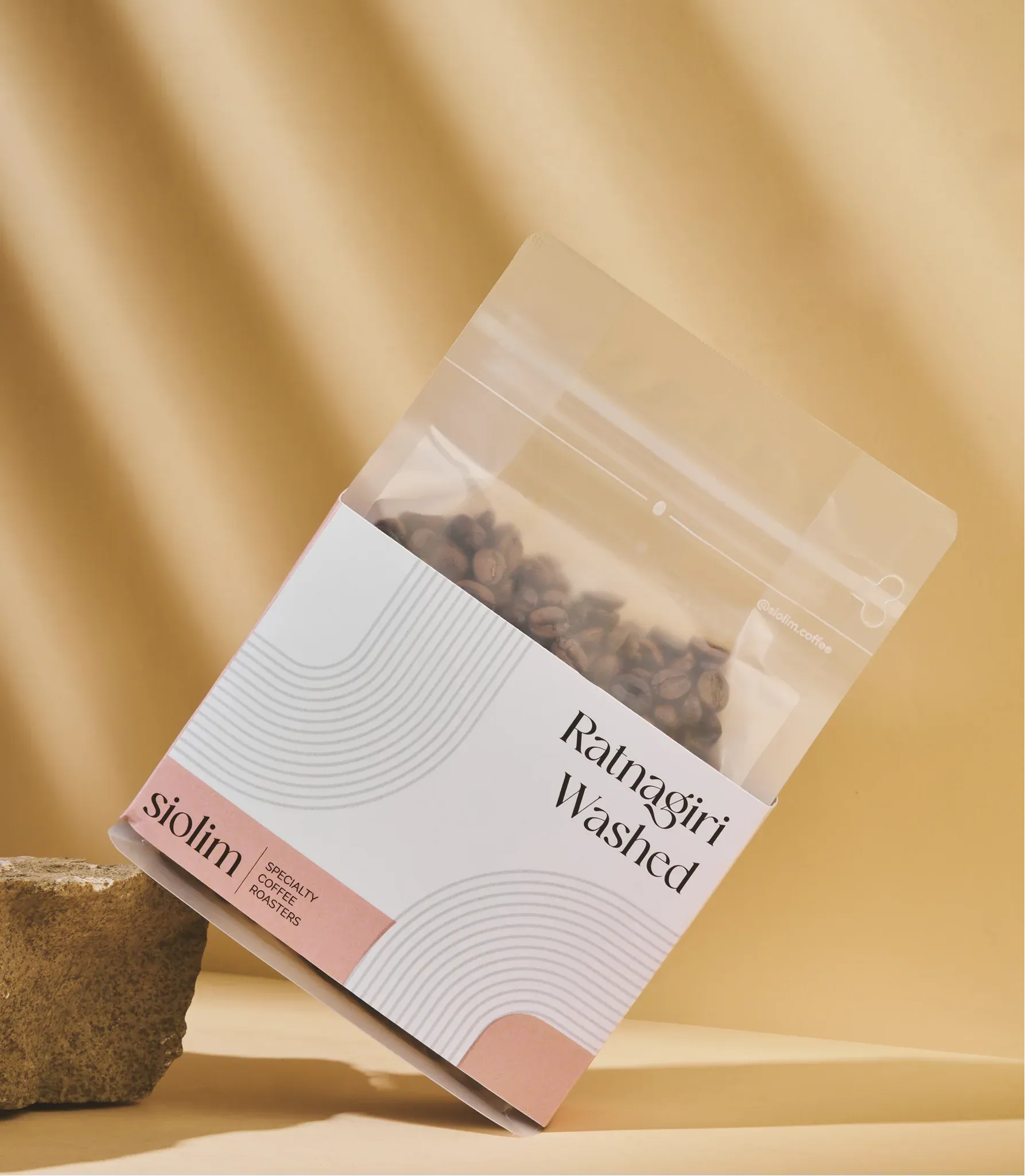
Baarbara Estate (Chikmagalur, established 1894 by M.G. Plantations, 1524m) is run by the Indavara family, now in its third generation. The estate grows SLN-795 Arabica and holds UTZ and Rainforest Alliance certifications. In the specialty market, Baarbara is widely noted for consistency — a flavor character that is broadly accessible and predictable across roasters who take its standard washed lots. It is frequently the first estate-named coffee buyers encounter, appearing across 16 roasters in the catalog.
Browse all coffees from Baarbara Estate
Baarbara's washed offering illustrates why this estate is used as a reference point — the flavor profile is familiar and consistent across the roasters who carry it. The highest-rated washed Baarbara lot currently in the catalog:

Same estate, different roasters
An estate produces cherry. What happens to that cherry — which processing method is applied, at what fermentation parameters, dried for how long, and then roasted to what level — determines what goes into the cup. Two roasters can source from the same estate in the same harvest year and produce entirely different coffees if they take different processing lots or apply different roast profiles to the same lot.
It's the most common confusion when buyers encounter an estate name they recognize from a different roaster. The estate name is fixed: it identifies the farm, its altitude, its varietal mix, and its growing conditions. Everything from cherry-picking onward varies — processing method, fermentation protocol, drying approach, green coffee selection, and roast treatment all differ by roaster and by lot.
The Ratnagiri Estate catalog illustrates this clearly:
Coffees from Ratnagiri Estate
No coffees found in this collection.
Explore CollectionComparing estate coffees across roasters: To make a meaningful comparison, hold one variable constant.
1. Fix the process — compare washed-to-washed or natural-to-natural from the same estate. A washed lot and an anaerobic natural from the same farm are not comparable cups.
2. Note the roast level — a light and a medium-dark from the same estate will emphasize different aspects of the terroir.
3. Check the harvest year — some roasters specify the crop year on the bag or on their website. Flavor characteristics can shift year over year within the same estate.
The estate name tells you where the coffee came from. The process, roast level, and harvest year tell you what the roaster did with it.
Where Indian coffee estates are concentrated
Karnataka produces 71% of India's total coffee output. Kodagu (Coorg) district alone accounts for roughly 33% of that. This concentration is reflected in the ICB estate catalog: most specialty estates with meaningful roaster representation are in Karnataka, with Chikmagalur and its surrounding sub-regions holding the highest density.
Five main geographic clusters account for the majority of named-estate coffees:
Chikmagalur / Bababudangiri is the dominant cluster in the catalog. Ratnagiri, Baarbara, Melkodige, Karadykan, and Kerehaklu estates are all here, along with the majority of the 134 named estates. Altitude typically runs 1000–1500m. The predominant variety is SLN-795 Arabica. The full range of processing methods — washed, natural, honey, and experimental — is represented.
Sakleshpur / Hassan sits slightly lower in elevation (roughly 800–1300m) and includes Salawara and Harley estates. Harley, established in 1864 and now run by the Kutumba family, is among the oldest continuously operating specialty-referenced estates in India. The Sakleshpur cluster tends toward more traditional processing alongside newer experimental lots.
Coorg (Kodagu) has fewer catalog entries than Chikmagalur but includes Mooleh Manay and Venkids Valley estates. Coorg has a higher proportion of Robusta cultivation alongside Arabica, and the washed Arabica lots from this cluster often show fuller body and spice-adjacent notes compared to Chikmagalur.
Biligiri Hills / Biligirirangan Hills is home to Attikan Estate, one of India's highest-elevation coffee-growing sites at up to 1650m. Fewer roasters source from this cluster than from Chikmagalur, though Attikan has established recognition across eight roasters in the catalog.
Shevaroy Hills, Tamil Nadu is represented primarily by Riverdale Estate, established in 1920 and now in its third generation. Riverdale is the main Tamil Nadu presence in the specialty catalog and is cultivating Gesha and SL9 varieties alongside standard Arabica — it represents a distinct growing ecology outside Karnataka.
Browse estate-attributed coffees from Chikmagalur
Estate coffee in the Indian specialty ecosystem
Estate attribution exists for 41% of the ICB catalog. The remaining 59% — region-only or blend-labeled coffees — are not lower quality by default. Many roasters develop well-regarded regional lots or house blends sourced from multiple farms without publishing estate names. The absence of an estate name means traceability stops at the region or cooperative level, not that the coffee is inferior.
Estate attribution enables comparison. When the same farm appears across 15 or 20 different roasters, a buyer can evaluate how different processing choices and roast approaches interpret the same raw material. No single roaster's website offers this view. The data shows, for example, that Ratnagiri Estate now produces seven distinct process variants — washed, natural, honey, anaerobic, carbonic maceration, double-fermented, and experimental — and each appears in multiple roasters' catalogs. The estate's flavor range across those lots is far wider than any one roaster's catalog would suggest.
Processing innovation at named estates has accelerated since roughly 2015. Estates with their own curing works and fermentation infrastructure — Ratnagiri being the clearest example — have the operational capacity to experiment with controlled anaerobic fermentation and extended maceration protocols that most smallholders cannot replicate. This has widened the flavor range available from individual estates while also making the estate name less predictive of a specific cup profile than it once was. The Indian specialty market isn't retreating from its dark-roast heritage; it's building on it. The same estate can now produce a clean, light-roasted washed lot and a wine-forward double-fermented natural. Processing infrastructure at a handful of named estates has effectively multiplied the flavor options available from a single terroir, without requiring buyers to seek out new origins.
For buyers, the estate name is the starting point. It identifies the terrain and altitude. The process, roast level, and roaster tell you what was done with it.
References
- PIB — Brewing Prosperity: India's Coffee Story from Farm to Global Fame (Ministry of Commerce)
- CWS India — Western Ghats Coffee Plantations and Bird Diversity
Related coffees
- Browse all coffees from Ratnagiri Estate
- Browse all coffees from Baarbara Estate
- Chikmagalur region overview
Placeholders requiring live data: Both coffeeSpotlight blocks (name, roaster, rating), coffeeCollection block (Ratnagiri process variety), donut chart percentages