


Building Your Personal Coffee Taste Profile
Most people who have tried several specialty coffees already have preferences — they just haven't mapped them to the variables that drive flavor. This article builds a four-axis framework that connects personal taste to the two signals printed on every specialty coffee bag: roast level and processing method. The result is a preference map that works across any Indian roaster's catalog.

Most buyers who have tried five or ten specialty coffees know what they liked. Fewer know why. The gap between "I liked that one" and "I prefer medium-roast washed coffees with chocolate and caramel notes" has nothing to do with vocabulary. It is about mapping preference to the right variables.
This article builds that map. Four preference axes, each tied directly to information printed on every Indian specialty coffee bag, form the framework. No tasting certification required. No flavor wheel necessary. The goal is a working preference profile that makes the next purchase more predictable than the last.
What a taste profile actually is
There is a difference between flavor vocabulary and a taste profile. Flavor vocabulary is descriptive: "this coffee shows stone fruit, dark chocolate, and a long finish." A taste profile is predictive: "I consistently prefer medium-bodied, smooth coffees with chocolate and caramel notes over bright, fruity light roasts." One describes a single cup. The other guides every future purchase.
The SCA Coffee Taster's Flavor Wheel is a professional calibration tool — 110 flavor, aroma, and texture attributes designed to align vocabulary between trained panelists. It was not designed for consumer preference mapping, and it is not the starting point for this exercise.
The framework here is simpler: four axes, each a spectrum between two ends. Locating yourself on all four produces a profile precise enough to filter any specialty catalog toward coffees likely to suit you.
Note: The taste profiling exercise is not about migrating toward any particular aesthetic. A well-defined preference for smooth, heavy, chocolatey coffees is as useful as one for bright, fruity light roasts. Precision is the goal, not movement in any particular direction.
The four preference axes
Four variables account for most of the taste preference variation between specialty coffee buyers. These axes are not a ranking — they are coordinates. The combination of your positions on all four produces a profile.
Axis 1 — Bright ↔ Smooth (perceived acidity)
Bright coffees produce a lively tartness on the sides of the tongue — citrus, berry, or stone fruit character with a snappy quality. Smooth coffees are mellow and rounded, with chocolate, caramel, or nutty character and lower perceived tartness. The main drivers are roast level (lighter roasts are brighter; darker roasts are smoother) and processing method (washed coffees are brighter relative to a natural at the same roast level).
Axis 2 — Light Body ↔ Heavy Body (mouthfeel)
Body refers to the weight and coating sensation of the liquid — not strength. Light body feels clean and transparent, similar to the texture of water or tea. Heavy body is viscous, coating, and stays on the palate. Processing method determines a lot here (natural processing produces heavier body; washed produces lighter), and so does brew method (immersion brewing — French press, South Indian filter — produces heavier body than percolation methods like pour-over). A light-bodied pour-over often reads as "weak" to buyers accustomed to South Indian filter decoction. This is a reference mismatch, not a quality deficit.
Axis 3 — Fruity ↔ Chocolatey (flavor family)
The most common preference axis in consumer coffee communication. Fruity covers stone fruit, berries, tropical notes, and citrus character — associated with lighter roasts, natural or honey processing, and certain origins. Chocolatey covers dark chocolate, milk chocolate, cocoa, caramel, and nutty notes — associated with medium to dark roasts and washed processing. Based on ICB's catalog of approximately 900 Indian specialty coffees, the chocolate and caramel families are the most common individual flavor notes, while the fruity family is larger in combined appearances but spread across many specific descriptors. Most Indian buyers begin at the chocolatey end; the fruity range requires calibration.
The fruity family's distribution across pomegranate, plum, stone fruit, citrus, raisin, and mango as separate note categories spans more distinct taste territory than the chocolatey cluster — whose character concentrates around fewer, more predictable notes. A buyer who considers themselves primarily chocolatey has a wider range to move into than the single-word descriptor implies.
Axis 4 — Restrained ↔ Intense (aromatic amplitude)
Restrained coffees are clean, balanced, and predictable — the aromatic character is present but measured. Intense coffees have amplified aromatics that dominate the cup: tropical, fermented, boozy, or florally saturated. Intensity is associated with natural processing and especially with anaerobic and carbonic maceration methods. A restrained washed medium roast from Chikmagalur and an anaerobic natural from the same estate are different experiences. Neither is better. They suit different preference positions.
Reading roast level as a flavor signal
Roast level is printed on every specialty coffee bag and is the most reliable single signal for predicting where a coffee sits on the four axes. The pattern across ICB's Indian specialty catalog is consistent:
| Roast Level | Typical Axis Position | Common Flavor Notes |
|---|---|---|
| Light | Bright + Light Body + Fruity | Floral, citrus, berry, pomegranate, guava, jasmine |
| Light-Medium | Transitional — fruit and sweet coexist | Caramel, citrus, milk chocolate, jaggery, stone fruit |
| Medium | Smooth + Medium Body + Chocolatey | Caramel, dark chocolate, milk chocolate, cocoa, citrus |
| Medium-Dark | Smooth + Full Body + Chocolatey | Dark chocolate, caramel, raisin, nuts, toffee |
| Dark | Heavy Body + Roast-forward | Dark chocolate, oak, spice — origin character diminishes |
Medium and medium-dark together account for roughly two-thirds of Indian specialty coffees in ICB's catalog. This reflects the current market position: most Indian specialty roasters are producing for buyers who know dark roast and are moving into the medium range, rather than buyers seeking light roast clarity.
Light roast accounts for roughly 9% of catalog entries — a proportion that suggests buyer demand for the format has not yet caught up with its growing prominence in Indian specialty conversations.
Starting point: If medium-dark is your current reference, the adjacent territory is medium — same chocolatey-smooth direction with slightly more flavor definition and less roast-forward character. A single-origin medium-roast washed Chikmagalur is the most consistent first step in this direction.
Reading processing method as a flavor signal
Processing method describes how the coffee cherry is handled between harvest and the dried green bean stage. It is the second most important flavor variable and the second piece of information on most specialty coffee bags.
| Processing Method | Axis Position | Typical Notes in Indian Coffees |
|---|---|---|
| Washed | Brighter + Cleaner + Lighter body | Dark chocolate, citrus, caramel, jaggery, milk chocolate |
| Natural | Sweeter + Heavier body + Broader range | Chocolate, plum, honey, raisin, caramel, fruity |
| Honey | Sweetest cluster + Intermediate body | Milk chocolate, caramel, orange, hazelnut, raisin, brown sugar |
| Monsooned (Malabar) | Smooth extremity + Maximum body + Minimum acidity | Pungent, musty, heavy, chocolate, spice |
| Anaerobic / Carbonic | Highest intensity + Variable acidity | Amplified fruit, fermented, tropical, sometimes boozy |
Washed processing removes the cherry pulp before drying, which produces cleaner flavor and higher perceived tartness. Natural processing dries the whole cherry with the pulp intact, imparting sweetness and fermented fruit character. The same estate's coffee at the same roast level tastes different depending on which method is used — a useful variable to isolate in comparative tasting.
Monsooned Malabar coffees sit at the extreme smooth end: long exposure to monsoon air during processing flattens acidity and builds body. These work well for buyers who find standard specialty coffees too bright but want traceability and Indian origin.
Washed is the dominant method, accounting for roughly 55% of ICB's Indian specialty catalog. Natural processing has grown substantially over the last several years and now represents approximately 23%. Honey and monsooned complete the mainstream picture; anaerobic and carbonic maceration remain a small but growing segment.
That distribution has a practical implication for first-time buyers: washed coffees will dominate most early encounters with Indian specialty, which makes natural processing a genuine discovery tier — more available than it used to be, but still not the default a new buyer is likely to reach first.
The Indian palate reference library
Specialty coffee vocabulary was largely developed in the West, from a Western sensory library. The SCA flavor wheel references peach, raspberry, blueberry, and blackcurrant. Most Indian buyers have encountered these fruits, but they are not the dominant reference points in the palate — jaggery, pomegranate, Alphonso mango, tamarind, sweet lime, and cardamom are.
These references map directly to specialty coffee vocabulary. They are not metaphors — many appear explicitly on Indian specialty bags and in the ICB catalog.
| Indian Reference | Coffee Vocabulary Equivalent | Axis Position | ICB Catalog Count |
|---|---|---|---|
| Jaggery / khaand | Brown sugar, molasses, unrefined caramel | Smooth, Medium-Heavy body | 19 coffees |
| Alphonso mango | Tropical fruit, stone fruit sweetness | Bright-to-Transitional, Light body | 12 coffees |
| Pomegranate (anaar) | Tart-fruity, red berry, structured brightness | Bright, Light body | 15 coffees |
| Tamarind (imli) | Sour-sweet depth, complex brightness | Bright, with intensity | 7 coffees |
| Sweet lime (mosambi) | Rounded citrus, less sharp than lemon | Moderately bright, clean | 11 coffees |
| Cardamom (elaichi) | Spice note, aromatic complexity | Intense, distinctive | 4 coffees |
If you know what jaggery tastes like, you already know what to look for in a medium-roast honey-processed coffee from Chikmagalur. If you know pomegranate, you have a reference for the tart-fruity brightness of a light natural from Coorg. The vocabulary gap between the SCA wheel and Indian specialty coffee is smaller than it appears.
These roughly 70 combined appearances represent different roasters applying the same Indian references independently, without a shared vocabulary standard. Aggregating that usage across dozens of roasters is what moves them from isolated bag labels toward something closer to a working cross-roaster vocabulary.
Note: These references do not appear on the SCA flavor wheel. Blue Tokai developed an Indian Flavour Wheel that replaces Western fruit references with Indian equivalents — it is the most significant India-specific contribution to this vocabulary to date.
Starting from where you already are
Most Indian specialty buyers enter from one of two coffee backgrounds: South Indian filter coffee (dark-roasted decoction, heavy body, bitter-sweet, typically served with hot milk) or instant coffee (Nescafé, Bru: dark-roasted or spray-dried, low complexity, often blended with chicory). Both sit at the smooth, heavy, chocolatey-to-bitter end of the four axes.
When a buyer from either background first encounters a light-roast washed coffee — bright, light-bodied, fruity — the cup reads as sour, thin, or not coffee. This is not a palate failure. It is a reference mismatch: the new coffee occupies the opposite end of two axes from the familiar baseline. The starting position is not wrong. The practical question is what sits adjacent to it.
For a buyer who reliably prefers smooth, heavy, chocolatey: the most accessible adjacent territory is a medium-roast single-origin washed coffee from Chikmagalur. Same smooth direction, better flavor definition than dark roast, cleaner body. From there: a medium honey-processed for more sweetness. A medium natural for body plus fruit. Each step changes one variable, making the shift legible.
That position on the axes — smooth, medium-full body, chocolatey — is the most accessible starting point for buyers coming from a dark-roast baseline: the same direction, with origin character that dark roast obscures. A medium washed Chikmagalur that sits there:

Browse medium roast washed Chikmagalur coffees
The two-cup comparative exercise
Tasting two coffees side by side calibrates a profile faster than assessing one in isolation. Side-by-side comparison forces a specific observation rather than a general impression — "this one was brighter, and I preferred the other one" rather than "I liked it." That difference in data quality is the point.
The exercise works as follows: order two coffees that share one variable and differ on another.
Useful pairings:
- Same region, different process: A washed Chikmagalur medium and a natural Chikmagalur medium from the same or a comparable roaster. This isolates the processing variable and reveals your body and sweetness preference.
- Same process, different roast: A washed light-medium and a washed medium from the same roaster. This isolates roast and reveals your acidity preference.
Brew both the same way — same ratio, same water temperature, same method. Taste each cup hot, then warm, then at room temperature. A coffee that reads sharp when hot often reads considerably sweeter at room temperature; this is particularly relevant for buyers who have dismissed light roasts as too acidic after tasting them straight off the brew.
After tasting, record one observation per axis: which was brighter? Which body suited you? Which flavor family did you prefer? Which felt more or less intense? Four answers from one session constitute a preference data point.
Browse light roast natural-processed coffees to find the second half of a washed vs natural pairing.
The goal of the two-cup exercise is not to name every flavor note. The goal is to answer: do I want more of what this coffee is doing, or less? That single directional observation per cup is sufficient.
Building a tasting log
A minimal tasting log requires four fields: roast level, processing method, liked or didn't (yes / no / interesting), and one observation — what stood out. That fits in a phone note or a spreadsheet row. After ten to fifteen coffees, patterns emerge without analysis: medium roasts appear more often in the "liked" column, or natural processing consistently shows up in the "interesting" entries. These patterns are a taste profile made explicit.
ICB's profile page tracks this automatically from your rating activity. When you rate coffees on ICB, the Taste Observations section derives your top roast levels, brew methods, and flavor tendencies from the accumulated record. It requires at least three ratings to generate and is visible only to you. The coffee log on the profile page also lets you mark coffees as logged, brewing, finished, or rated — a way to track what you have tried across multiple roasters without maintaining a separate record.
A note on bag notes: The flavor descriptors printed on specialty coffee bags are the results of professional cuppings conducted in controlled conditions. Brewing at home with a single method typically produces one or two dominant notes rather than the full list. The bag's descriptors are a directional signal about flavor family — not a pass/fail test for the cup in your hand.
Using your taste profile as a filter
The four axes map directly to the searchable filters in ICB's coffee directory: roast level (five options), processing method (washed, natural, honey, monsooned, anaerobic), and flavor notes (browsable by family — fruity, chocolatey, nutty, floral, earthy). A buyer who knows they prefer medium roast, washed processing, and chocolate or caramel character can apply those three filters to the full catalog — approximately 900 Indian specialty coffees across more than 60 roasters — and return a precise subset without starting from scratch each time.
The profile page extends this into a running record. The Selections section surfaces the coffees you have rated above three — a personal shortlist built from actual tasting history rather than editorial curation. Over time, the Taste Observations section shows which roast levels, brew methods, and flavor tendencies show up most in the coffees you rated highly. The profile becomes a record of what you tried, what you returned to, and what the data suggests you tend to seek.
The taste profile is roaster-agnostic. The same preference framework applies to a catalog from a roaster in Bangalore, one in Mumbai, and one in Delhi. Build it once; it works across every bag.
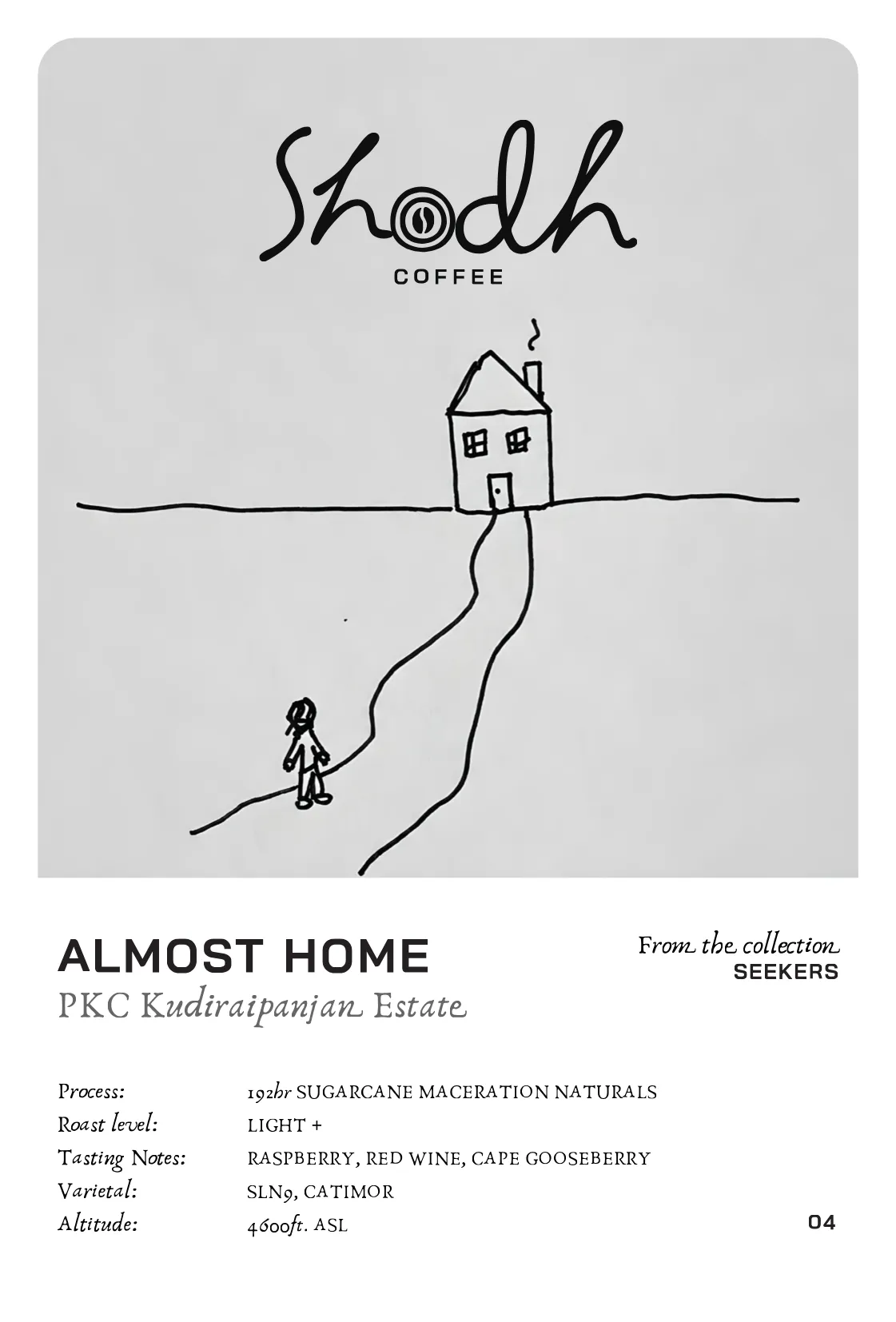
The opposite end of that profile is a light natural — transitional brightness, fruit character in place of the chocolate register, less citrus-driven than a light washed coffee:
Browse coffees with fruity notes
Related
- Medium roast washed Chikmagalur coffees
- Light roast natural-processed coffees
- Coffees with fruity notes
- Monsooned Malabar coffees
- Your ICB profile — Taste Observations
Humanizer notes
Humanized: 2026-04-10
Changes made:
- Intro (para 1): Removed negative parallelism "is not a matter of vocabulary — it is a matter of mapping" → "has nothing to do with vocabulary. It is about mapping"
- Intro (para 2): Removed passive "The framework is built around four preference axes, each of which corresponds directly to" → "Four preference axes, each tied directly to... form the framework"
- Axis 2: Varied "The primary predictors are" (used identically in Axis 1) → "Processing method determines a lot here... and so does brew method"
- Two-cup section opener: Removed negative parallelism "is not to assess a single coffee in isolation — it is to taste two coffees side by side" → direct active construction
- Two-cup section (sentence 2): Removed elegant variation cycling general impression/comparison as parallel subjects → collapsed into one sentence with the examples integrated
- Taste filter section: Tightened "appear most consistently in the coffees you preferred" → "show up most in the coffees you rated highly"
- Taste filter closer: Replaced passive "Once the profile is established, it is portable across every bag" → "Build it once; it works across every bag"
- All headings: Converted to sentence case (title case was inconsistent in the reviewed draft)